
Teaching kids to compare grocery prices can start with one item on your shopping list. You do not need a full-store challenge or a lecture about the family budget. Two packages, a simple question, and a few minutes are enough to practice a useful decision.
Quick answer: Pick one item you already need, compare two packages, and work out the unit price together: package price ÷ quantity. Then ask whether the lower unit price actually fits your family (will you use it, can you store it, does it fit today’s limit?). Five minutes, one item, and a calm “why did we choose this?” is the whole lesson. Ages 8–12 is the sweet spot, with easier and harder versions below.
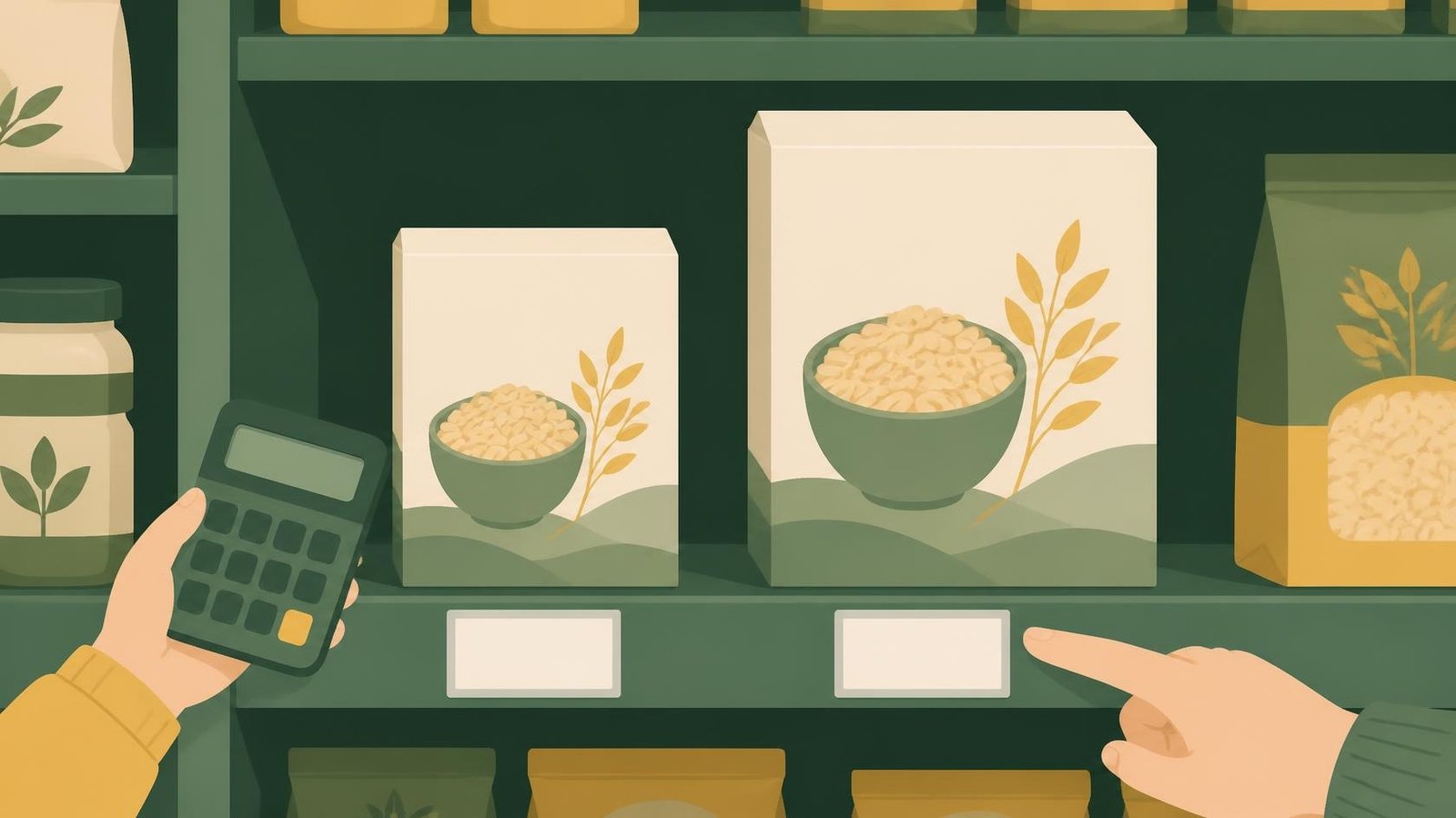
This activity is designed for children roughly ages 8–12, with easier and more advanced versions below. Adjust it to your child’s comfort with numbers. The aim is to explain a choice, not to find the cheapest possible basket or make children responsible for household finances.
Start with one purchase you already need
Choose a familiar item such as oats, rice, or crackers. Check food allergies, dietary needs, and preferences first so both options are genuinely usable. A lower price does not make an unsuitable product a good choice.
Before leaving home, say: “We need oats for breakfast. Would you help me compare two packages?” Make the shopping list together and set a small boundary: you will compare this one item, then finish the trip. You can also practice with packages and receipts at home without buying anything.
The Consumer Financial Protection Bureau’s Money as You Grow guidance encourages parents to explain everyday choices and compare prices and features. Its planning activity suggests making a list before shopping. The example below is an original practice exercise, not a report of current store prices.
Teach kids to compare grocery prices in three steps
1. Find the package price
Ask your child to find what you pay for the whole package. Explain that this is the amount the purchase uses from today’s budget, before any applicable taxes or fees. A big package may offer more food, but you still need enough money to pay its full price now.
For a first try, compare two packages of the same size. If both contain 12 ounces and cost $3 and $4, the price difference is easy to see. Then ask whether there is another reason your family would choose one over the other.
2. Compare the same amount
Different package sizes make the sticker prices less useful on their own. A unit price tells you the cost of a standard amount, such as one ounce or one pound. Some shelf labels show it; when they do, make sure both labels use the same unit and match the products in front of you.
Unit price = package price ÷ quantity in the package. Use a calculator together. There is no prize for mental arithmetic while standing in an aisle.
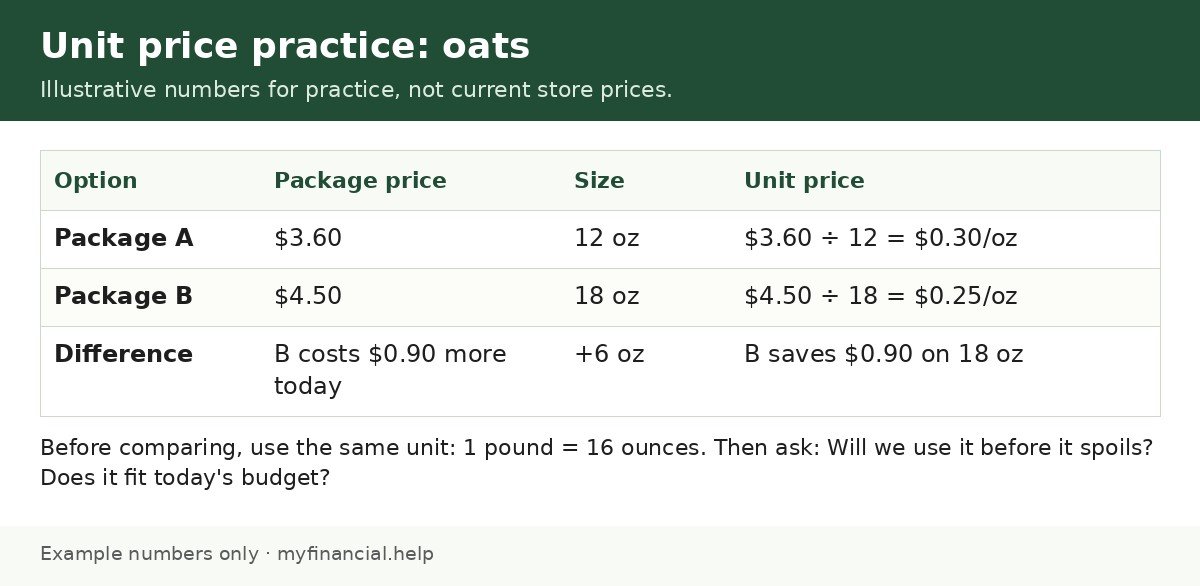
- Practice package A: 12 ounces for $3.60. $3.60 ÷ 12 = $0.30 per ounce.
- Practice package B: 18 ounces for $4.50. $4.50 ÷ 18 = $0.25 per ounce.
Package B costs less per ounce, but costs 90 cents more to buy today. At package A’s rate, 18 ounces would cost $5.40, so B costs 90 cents less for that same quantity. These are illustrative numbers; check the actual shelf and checkout prices in your store.
Why the unit price label is worth teaching now
Unit price labels are not shown the same way everywhere. According to the National Institute of Standards and Technology (NIST), nineteen states and two territories have unit pricing laws or regulations, and only eleven jurisdictions make unit pricing mandatory. In other places it is voluntary. NIST also points to Bureau of Labor Statistics research on “shrinkflation,” where a package shrinks while the price stays the same. A child who can do the division can check the label, or do the math when there is no label.
Prices are still moving, too. The USDA Economic Research Service’s September 2026 Food Price Outlook forecasts grocery (food-at-home) prices to rise 2.4% in 2026, with much bigger swings in some categories. That makes “compare the same amount” a skill that keeps paying off.
3. Ask whether the lower unit price fits your family
A unit price is one piece of the decision. Ask: Will we use it before it spoils? Can we store it? Does everyone who will eat it like it? Is the larger total price within today’s limit? Are the ingredients and quality suitable?
Choosing the smaller package can be reasonable even when its unit price is higher. Explain the tradeoff plainly: “The large box is cheaper per ounce, but we only need a little this week. We are choosing the smaller amount.”
A five-minute conversation you can use
Parent: “Which package costs less to take home today?”
Child: “The $3.60 one.”
Parent: “Right. Now which costs less for each ounce?”
Child: “The bigger one, at 25 cents.”
Parent: “What else should we check before choosing?”
Let your child suggest a reason before offering yours. If they choose differently from you, explain your own thinking without turning their answer into a failure. “You noticed the lower unit price. I am also thinking about whether we have room for it.”
End with a single reflection: “What helped us decide?” Recognizing package size, noticing a condition on a sale, or asking about waste all count as useful observations.
Watch for these comparison traps
- Different units: Do not directly compare a price per ounce with a price per pound. Convert to the same unit first; one pound is 16 ounces.
- Different products: Concentrated and ready-to-use products may need a different comparison. Keep the first exercise simple by choosing similar foods in the same form.
- Conditional deals: Read whether a displayed price needs a loyalty account, coupon, or minimum quantity. Do not assume a multi-buy sign gives the same discount on one item.
- Buying extra to save: An unused bargain still uses money and storage. Stick to the purpose of the shopping list.
- Ignoring the receipt: Check that the charged price matches the offer you qualified for. Ask store staff about a discrepancy politely.
Adapt the activity by age and confidence
For younger children or beginners: Compare equal-size packages and whole-dollar prices. Ask them to spot which costs more and name one feature that matters. You can handle the arithmetic.
For children ready for division: Use the two-package example, write down each quantity, and calculate unit prices together. Let them explain both the lower total price and the lower price per ounce.
For teens: Add one realistic condition, such as a delivery fee or a coupon requiring an extra purchase. Compare the final amounts your family would actually pay. Avoid creating an account or buying something simply to complete the exercise.
At-a-glance: the grocery comparison by age
| Age | Your child does | You do | Stretch goal |
|---|---|---|---|
| 5–7 | Finds two packages of the same item and says which costs more | All math and the final choice | Names one reason besides price (“we like this one”) |
| 8–10 | Reads the package price and size; compares same-size packages | Helps with the calculator | Explains why the bigger box can cost more today but less per ounce |
| 11–13 | Calculates unit prices and converts pounds to ounces | Sets the item and the limit | Spots a conditional deal (loyalty card, “2 for $5”) |
| 14+ | Compares the final cost, including delivery fees or coupons | Reviews the choice afterward | Plans one meal within a set budget |
What to say when your kid asks…
- “Why can’t we get the name brand?” “Sometimes we do. Today we compared, and this one does the same job for less. Want to taste-test them at home?”
- “Why are we buying the big one if it costs more?” “It costs more today, but less for each ounce, and we eat oats every morning. If we wouldn’t finish it, we’d buy the small one.”
- “Are we poor because we compare prices?” “Comparing is how careful shoppers make sure money goes to what matters most. Lots of families do it.” If your child seems worried, see How to Talk to Kids When Money Is Tight.
- “Can I keep the money we saved?” Decide this ahead of time. Some families let the child choose where a small “saved” amount goes; others keep the grocery budget separate from allowance.
Find your child’s next money skill (tool walkthrough)
Price comparison is one of five skills in our free What Should My Child Know Next? assessment. Here is an example run, with made-up answers for a 9-year-old:
Example inputs and result (illustration only)
- Child’s age: 9
- Can track money received and spent: With help
- Can save toward a chosen goal: Independently
- Compares prices and tradeoffs: Not yet
- Understands digital spending and scams: With help
- Understands accounts, paychecks and credit: With help
The tool ranks the weakest skills first and returned: 1. Comparing prices and tradeoffs (not yet), 2. Tracking money (with help), 3. Digital spending and scams (with help), practiced one skill per week. For this child, the grocery activity above is the right next step.
Printable grocery comparison sheet
Print this section, or copy the lines onto the back of your shopping list.
- ☐ Item we need: ____________
- ☐ Option A: size ______ price ______ unit price ______
- ☐ Option B: size ______ price ______ unit price ______
- ☐ Same unit? (1 lb = 16 oz) ☐ yes
- ☐ Will we use it before it spoils? ☐ yes ☐ no
- ☐ Fits today’s limit? ☐ yes ☐ no
- ☐ What we chose and why: ____________
- ☐ Next trip: did the amount we bought work? ____________
Bring the lesson back home
Make a quick record with four lines: what we needed, the two options, what we chose, and why. At the next trip, check whether the amount you bought worked. This turns price comparison into a habit of noticing and adjusting.
For more everyday practice, visit our Saving & Spending guide. Connect thoughtful purchases with a child’s savings goal, or discuss the exercise at your next family money meeting. The family budget planner can help adults show how purchases fit into a plan without sharing details that feel too private.
Try one comparison this week. Keep the conversation calm, accept that convenience and food needs matter, and praise the reasoning rather than the amount saved. For a broader path through family money skills, start here.
Sources
- Consumer Financial Protection Bureau: Money as You Grow, school-age children and preteens
- Consumer Financial Protection Bureau: Explore planning activity
- NIST: Uniform Unit Pricing, Tools for Consumers to Fight Shrinkflation
- USDA Economic Research Service: Food Price Outlook, Summary Findings (September 2026)
This article provides general financial education, not individualized financial, investment, tax, or legal advice. Examples are illustrative. Adapt activities and spending decisions to your family’s needs.




Leave a Reply