
Your son found a used car he loves. Your daughter is ready to move into her first apartment. The lender says, “We’ll need a co-signer.” Suddenly you are the one holding the pen. Saying yes can feel like helping; it is also a legal promise. Should you co-sign a loan for your child? This guide explains what co-signing really means, the questions to ask before you sign, and several ways to help your child that do not put your own finances on the line.
Quick answer: Co-sign only if you could comfortably pay the entire loan yourself and you are fine with the debt showing on your credit reports. A co-signer is not a character reference. You are promising to repay if your child does not. If that feels like too much, consider a smaller loan, a bigger down payment, a lower-cost purchase, or a gift instead of a guarantee.
What it means to co-sign a loan for your child
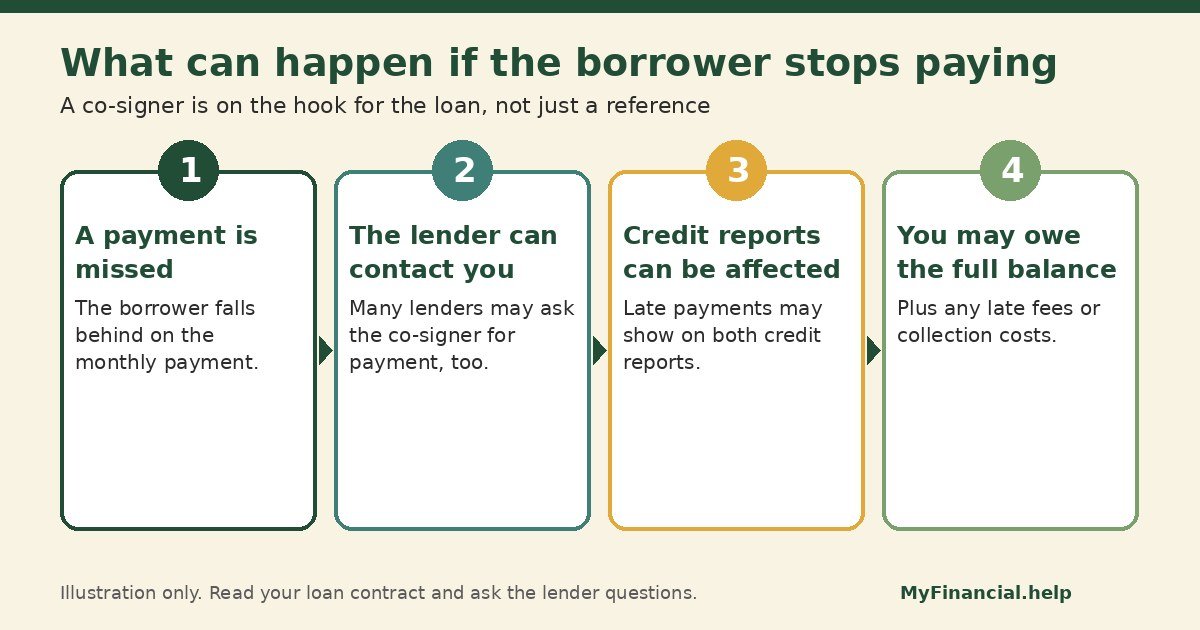
A co-signer guarantees a debt for someone else. The lender approves the loan partly because of your income and credit history. In return, the lender can come to you for the money if the borrower stops paying.
The Federal Trade Commission’s Credit Practices Rule spells this out in a notice that covered lenders must give co-signers before they sign. In its plain wording: “If the borrower doesn’t pay the debt, you will have to.” The same notice warns that you may owe the full amount plus late fees or collection costs, and that the creditor can collect from you without first trying to collect from the borrower.
That is the part many parents miss. You do not own the car or live in the apartment, but you carry the risk as if you did.
The risks to you as the parent
- You may owe the whole balance. Not a share. If your child cannot pay, the lender can ask you for the full payment.
- Late payments can hurt your credit. The loan generally appears on your credit reports too, so a missed payment may lower your scores even if you never knew it happened.
- It can limit your own borrowing. Another lender may count the co-signed loan as one of your debts when you apply for a mortgage or refinance.
- Collection can reach you. If a lender sues and wins, wages or property could be at risk, the same as for the borrower.
- It can strain the relationship. Money problems between a parent and a young adult are hard enough without a legal tie.
Rules and lender practices vary, so read the actual contract and ask the lender to explain anything that is unclear.
Co-signer or co-borrower: what is the difference?
The two terms get mixed up. A co-signer guarantees the loan but usually has no ownership of the thing being bought. A co-borrower (sometimes called a joint applicant) shares both the debt and the ownership or use. Ask the lender which role they are asking you to take, how it will be listed on the paperwork, and how it will appear on your credit reports. The Consumer Financial Protection Bureau explains what a co-signer is in plain language, and it is worth reading before you decide.
Five questions to ask before you sign
- Could I pay this loan every month if my child could not? Look at the full monthly payment and the full length of the loan, not just the first year.
- Is the loan sized sensibly? Our guide to buying a car with loan-to-value in mind shows how a large loan on a fast-depreciating vehicle can leave a young buyer owing more than the car is worth.
- Does my child have steady income and a plan? A written monthly budget is a good sign. A vague “I’ll figure it out” is not.
- Can I see the account? Ask for online access or automatic alerts so you hear about a missed payment right away, not months later.
- How do I get released? Some lenders offer a co-signer release after a period of on-time payments, or the borrower can refinance alone later. Ask for the rules in writing before you sign, because terms differ.
If any answer makes your stomach drop, that is useful information.
Safer ways to help your child
Shrink the ask
A cheaper car, a smaller apartment, or a bigger down payment can sometimes bring the loan within your child’s own reach. Our Debt Payoff Calculator shows how quickly a balance falls at different monthly payments, which helps you test whether a plan is realistic.
Give help instead of a guarantee
If you can afford it, a one-time gift toward a down payment or deposit has a clear ceiling. Once it is given, your risk is over. A co-signature has no ceiling at all.
Build your child’s own credit first
A teen who has used a debit card responsibly and learned the basics of credit is in a better position later. Start with debit versus credit for teens, then look at the hub for teen banking and credit for the next steps.
Look at lenders that work with first-time borrowers
Credit unions, banks, and other lenders have different rules for first-time borrowers and often have different rates. Compare at least three offers, and ask each lender whether a co-signer is truly required.
If you decide to co-sign
- Put your agreement in writing with your child: who makes the payment, on what date, and what happens if they are late.
- Set up payment alerts or account access so you can see problems early.
- Check your own credit reports now and then. Our guide to reading your credit report and disputing errors walks through it.
- Keep an emergency cushion that could cover a few payments.
- Review the plan together every few months and talk about when you can come off the loan.
How to say “not yet” without hurting the relationship
Saying no is not the same as saying you do not believe in your child. Try something like this: “I love that you are ready for this step. I can’t sign for the loan, because I’d be responsible for all of it if something went wrong. Here is what I can do: help you build a plan, and chip in toward a down payment.” Our Money Conversation Generator can help you find the right opening for a conversation like this.
Common questions
Does co-signing help my child build credit?
It can. On-time payments are generally reported for the account, which can help build the borrower’s history. But missed payments hurt both of you.
Can I be removed from the loan later?
Sometimes. Options include a lender’s co-signer release program, or the borrower refinancing in their own name. Neither is guaranteed, so get the lender’s policy in writing before you sign.
What if my child stops paying?
The lender can ask you for payment. Contact the lender early to discuss options, and do not wait for the account to go to collections.
Is co-signing the same as being a guarantor?
The two terms are close in everyday use. Both mean you promise to repay if the borrower does not. Check the exact wording on the paperwork.
Will co-signing affect my own ability to borrow?
It can. Lenders may count the debt when they calculate how much more you can borrow.
Sources
- Electronic Code of Federal Regulations: 16 CFR 444.3, Unfair or deceptive cosigner practices
- Consumer Financial Protection Bureau: What is a co-signer on a loan?
This article is for educational purposes and does not provide individualized financial, legal, or tax advice. Example numbers and scenarios are illustrations only.




Leave a Reply