
There is no single correct allowance for every child. A useful amount is one your family can afford consistently and your child can use to practice real choices. The question is not only “How much?” It is also “What must this money cover?”
Quick answer: Many families start around $2–$5 a week for ages 6–8, $5–$10 for ages 9–12, $10–$25 for ages 13–15, and $50–$150 a month for ages 16–18. Those are our editorial starting ranges, not survey averages. The right number for your child is a small practice base plus the cost of any expenses you hand over. Check the base in the free Allowance Builder, add the handed-over costs, and review after four paydays.
A six-year-old whose allowance is only for small treats needs far less than a sixteen-year-old expected to pay for lunches with friends, clothing extras, transportation, and subscriptions. Start with the job you want the allowance to do, then choose the amount.
A flexible allowance-by-age starting table
Use these ranges as conversation starters, not rules. Adjust for your household budget, local prices, the child’s maturity, and the expenses you are transferring. The last column shows what our Allowance Builder suggests as a weekly practice base before any expenses are handed over (learning model, no paid jobs).
| Age | Simple starting range | Typical schedule | Good first responsibilities for the money | Allowance Builder practice base (weekly) |
|---|---|---|---|---|
| 6–8 | $2–$5 | Weekly | A small treat, low-cost toy savings, a small giving choice | $2–$6 (ages 6–7), $3–$7 (age 8) |
| 9–12 | $5–$10 | Weekly | Snacks or entertainment extras, gifts, a larger savings goal | $3–$7 (age 9) to $5–$9 (ages 11–12) |
| 13–15 | $10–$25 | Weekly | Social spending, selected clothing extras, hobbies, saving | $6–$10 (ages 13–14), $7–$11 (age 15) |
| 16–18 | $50–$150 | Monthly | A defined mix of transportation, meals out, clothing, subscriptions, and savings | $8–$12 (ages 16–17), $9–$13 (age 18) |
Notice the gap between the two money columns for teens. That gap is the point: the range should expand only when the child takes responsibility for more expenses. A larger allowance is not necessarily more generous if the teen must use it for costs a parent previously paid directly.
Why start practice early? The Consumer Financial Protection Bureau’s youth research describes middle childhood (ages 6–12) as the stage when financial habits and norms begin to form. A small, predictable allowance gives those habits something real to practice on.
The build-up method: practice base + handed-over costs
Instead of guessing one number, build it from two parts:
- Practice base. A small amount the child manages freely, so they can save, wait, compare, and occasionally make a mistake. This is what the Allowance Builder estimates.
- Handed-over costs. The realistic monthly cost of anything you are moving from your budget to theirs, such as meals out with friends, a subscription, or hobby supplies.
Allowance = practice base + handed-over costs. Optional paid jobs, if you use them, sit on top and are earned separately. See Should Allowance Be Tied to Chores? for how to keep the two apart.
Worked example: using the Allowance Builder
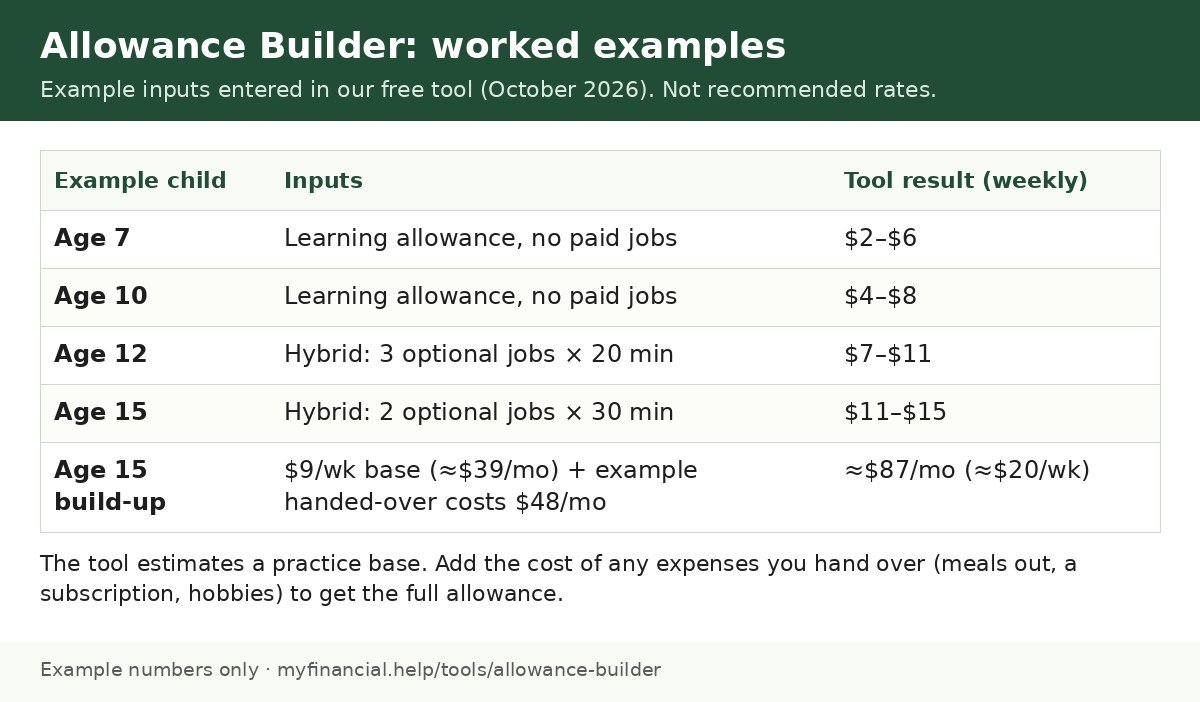
We entered four example children into our free Allowance Builder in October 2026. The tool is a starting point, not a rate card. All numbers below are examples.
Example A: age 7, learning allowance
Inputs: age 7, “Learning allowance,” 0 paid jobs, covers “treats and small toys.” Result: a suggested weekly range of $2–$6, paid weekly, reviewed after four weeks. Many families would pick a number near the middle, such as $4, and keep basic needs parent-paid.
Example B: age 12, hybrid system
Inputs: age 12, “Hybrid system,” 3 optional paid jobs a week, about 20 minutes each. Result: $7–$11 a week. That range includes the optional jobs, so a week with fewer jobs should land lower.
Example C: age 15, full build-up
Inputs: age 15, “Learning allowance,” no paid jobs. Result: a practice base of $7–$11 a week. Using the middle, $9 a week is about $39 a month ($9 × 52 ÷ 12).
Now add example handed-over costs the teen will manage: meals out with friends ($30 a month), one streaming subscription ($8), and hobby supplies ($10). That is $48 a month. Total: about $87 a month, or roughly $20 a week. Prices in your area will differ; list your own.
A better way to calculate the amount
1. List what the allowance will cover
Separate expenses into three groups:
- Parent-paid essentials, such as basic clothing, school supplies, food at home, and required transportation.
- Child-controlled extras, such as treats, entertainment, nonessential upgrades, and gifts.
- Savings or giving goals the child will fund from the allowance.
For a younger child, transfer only one or two small choices. For a teen, you can gradually transfer more responsibility.
2. Estimate a realistic month
Add the likely cost of the child-controlled extras. Do not inflate the amount to prevent every disappointment. An allowance works best when the child sometimes has to wait, compare options, or decide that one purchase matters more than another.
3. Check the family budget
Consistency matters more than matching another family. If the amount would be hard to maintain, lower it and reduce what the child is expected to cover. Avoid promising an amount that will frequently be delayed or changed.
4. Build in a review date
Set a review every three to six months, or whenever the list of covered expenses changes. A review is not an automatic raise. Ask what the child learned, what felt unrealistic, and whether a different schedule would work better.
Our Allowance Agreement
Suggested ages 6–15 · PDF · 1 page
Agree on payday, spending responsibilities and a review date together.
Weekly or monthly allowance?
Weekly payments usually work better for elementary-age children because the wait is short and mistakes are easier to recover from. A fixed payday also makes the system predictable.
Monthly payments give teens practice planning across a longer period. Before switching, help the teen list known expenses and divide the total into weekly limits. A transition month with two half-month payments can make the change easier.
Example allowance setups
These are illustrative families, not real case studies.
Age 7: learning to choose
Jordan receives $4 each Friday. The money may be spent on small extras or saved for a toy. Basic needs remain parent-paid. Jordan chooses to save $1, give 50 cents, and decide what to do with the rest.
Age 11: planning for more than one goal
Maya receives $8 each week. She pays for occasional school snacks and birthday gifts for friends, saves for a game, and keeps a small amount available for spontaneous spending.
Age 15: taking over selected expenses
Alex receives $60 each month. The amount covers meals out with friends, one streaming subscription, gifts, and personal savings. Parents still cover meals at home, school needs, basic clothing, and required transportation.
Should the amount equal the child’s age?
Some families use a simple formula such as one dollar per year of age each week. It is easy to remember, but it is not automatically right for your budget or the expenses involved. Treat any formula as a starting point. The final number should follow the list of costs the child is expected to manage.
What if siblings receive different amounts?
Fair does not always mean equal. An older child may receive more because the allowance covers more. Explain the difference in responsibilities, not just the difference in dollars. Keep the rules for reviews, advances, and missed payments consistent.
Try: “Your sister gets more because her allowance pays for her lunches out and her phone game. When you take over something new, your amount will change too.”
What to say when your kid asks about allowance
| Your child says | Ages 6–9 | Ages 10–13 | Ages 14–18 |
|---|---|---|---|
| “My friend gets way more.” | “Families choose different amounts. Ours is for treats and your saving jar.” | “What does your friend’s money have to pay for? Ours covers these three things.” | “Show me what you would take over for a higher amount, and we will price it together.” |
| “Can I have next week’s money now?” | “Payday is Friday. Let’s mark it on the calendar.” | “Advances are not part of our plan. What could you do while you wait?” | “If we ever allow an advance, it gets written down and repaid from the next payday.” |
| “I spent it all. Can I have more?” | “It’s okay to feel disappointed. Your next money comes Friday.” | “What would you do differently next week?” | “Let’s look at where it went and decide one change for next month.” |
| “Can I get a raise?” | “We review on our review date.” | “Bring me a list of what costs more or what you want to take over.” | “Let’s compare your actual spending for the last month against the plan.” |
For a longer “spent it all” plan, see What to Do When a Child Spends All Their Allowance. To generate a conversation starter for a specific moment, try the Money Conversation Generator.
Avoid these common allowance mistakes
- Giving extra money every time the child spends too quickly.
- Changing the rules after a purchase you dislike.
- Making the amount too complex to track.
- Expecting an allowance to teach money skills without regular conversations.
- Transferring an expense without giving enough money to cover a reasonable version of it.
The Consumer Financial Protection Bureau emphasizes that the conversation about a child’s plan for the money is a central part of the learning. A simple five-minute check-in on payday can be more valuable than a complicated reward chart.
A five-minute allowance check-in
Ask:
- How much do you have now?
- Is there anything you want before the next payday?
- What are you saving for?
- Did anything surprise you about your spending?
- Do you want advice, or do you already have a plan?
Then let safe, affordable mistakes teach. If the money is gone, the next payday—not an immediate rescue—is usually the cleanest reset.
Printable allowance setup checklist
Print this section or copy it into your notes app.
- ☐ List what the allowance will cover (and what stays parent-paid)
- ☐ Run the Allowance Builder for a practice base
- ☐ Add the monthly cost of any handed-over expenses
- ☐ Pick a payday and a schedule (weekly for younger kids)
- ☐ Decide the rule for advances and running out early
- ☐ Decide whether optional paid jobs exist, and keep them separate
- ☐ Agree on saving and giving, if you use jars or accounts
- ☐ Write the review date (after four paydays, then every 3–6 months)
- ☐ Both adult and child can explain the plan back in one sentence
Common questions
What if we can only afford a very small allowance?
A small, reliable amount teaches more than a larger amount that is often skipped. Hand over fewer expenses and keep the payday consistent. Our guide to talking to kids when money is tight has wording for that conversation.
When should allowance stop?
Many families phase it down as a teen starts earning, by handing more expenses to the teen’s own pay. The First Paycheck Decoder helps a working teen see what a job really leaves after withholding and work costs.
Choose a starting amount
Use the Allowance Builder to compare an amount, schedule, and list of covered expenses. Then read Should Allowance Be Tied to Chores? to choose the family system that fits your goals, and Save, Spend and Give Jars to decide where the money goes.
Sources
- Consumer Financial Protection Bureau: School-age children and earning
- Consumer Financial Protection Bureau: Building blocks to help youth achieve financial capability (2016)
- Consumer Financial Protection Bureau: Money as You Grow
- FDIC: Money Smart for Young People
- Utah State University Extension: Teaching Children Money Management
This article is for educational purposes and does not provide individualized financial, tax, legal, or investment advice. Example numbers are illustrations, not recommended amounts.




Leave a Reply