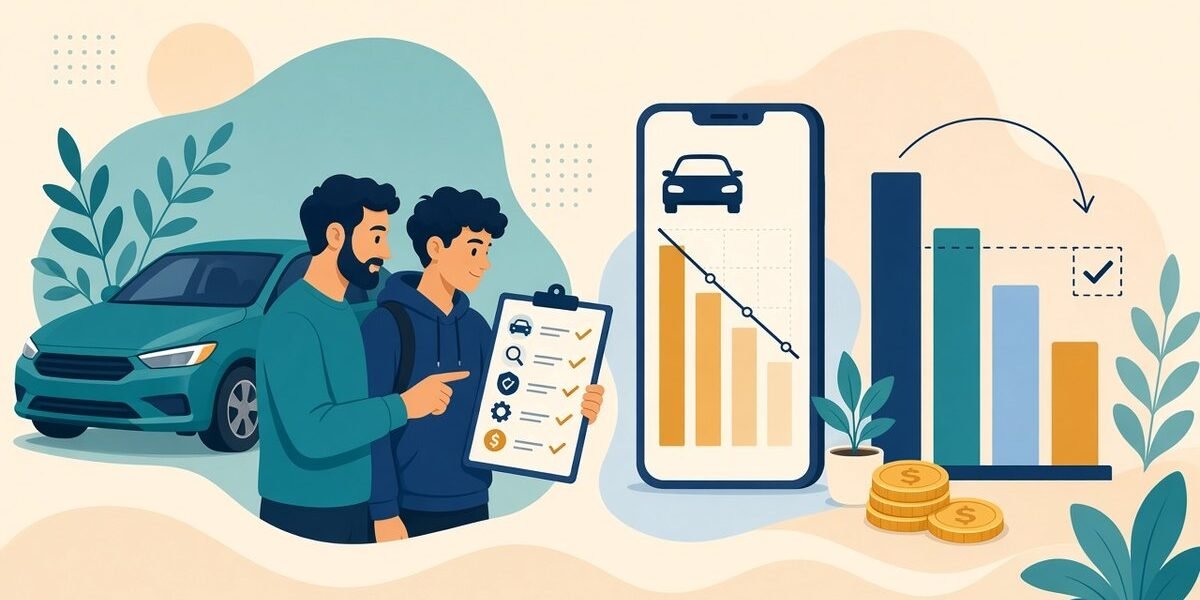
Buying a car—especially your first car in high school, college, or right as you start working—is one of the biggest financial decisions you will make. Walk onto a dealership lot unprepared, or wait until your current vehicle breaks down and you need a ride by Monday morning, and it is easy to walk out with an overpriced vehicle, rolled-in fees, and an interest rate that costs you thousands of extra dollars over the life of the loan.
Drawing on real-world lending experience—Erik Edgington has worked in banking and credit unions since 2010 and serves as a credit union office manager—this guide walks high school students, parents, and first-time car buyers through how auto loans actually work behind the scenes. You will learn how to check a vehicle’s true book value, how lenders calculate Loan-to-Value (LTV), how down payments at 90% or 80% LTV can unlock discounted interest rates, how trade-in wholesale values and negative equity work, and why dealerships love to mark up interest rates when they send your credit package out to multiple lenders.
Quick answer: The 5 rules of smart car buying
- Do your homework before your back is against the wall: Never combine car shopping, financing, and trade-in negotiations into one monthly-payment conversation.
- Get pre-approved at your credit union or bank first: Know your true baseline APR, maximum loan amount, and whether hitting 90% or 80% Loan-to-Value (LTV) earns you a rate discount.
- Check the J.D. Power book value before making an offer: Lenders typically price your loan against J.D. Power values (plus Kelley Blue Book and Edmunds). If you overpay, your LTV spikes immediately.
- Watch what gets rolled into the loan: Sales tax, title/registration, dealer document processing fees (doc fees), GAP insurance, maintenance packages, and negative equity from a trade-in all push your LTV higher—which can trigger a higher interest rate and a larger monthly payment.
- Negotiate three numbers separately: Agree on the out-the-door purchase price of the car first, the wholesale trade-in value second, and the APR/financing last.
Free Printable User Guide: Smart Car-Buying & LTV Worksheet (PDF)
Taking a printed worksheet to the credit union and the dealership keeps every number in front of you so nothing gets hidden inside a monthly payment quote. Our free 2-page Smart Car-Buying & Loan-to-Value (LTV) Worksheet for Teens & First-Time Buyers requires no account, login, or personal information.
Download the Printable Car-Buying & LTV Worksheet (PDF) →
Includes Step 1: Pre-Shopping Lender Check • Step 2: Side-by-Side Vehicle Book Value Lookup • Step 3: Out-the-Door & LTV Calculator Box • Step 4: Trade-In Equity Check • Step 5: Finance Office Red-Flag Checklist. Looking for more worksheets? Visit our Printable Money Worksheets library.
1. Do Your Homework Before Your Back Is Against the Wall
The worst time to shop for a car is when you have no choice—when your current car breaks down on the way to school or work, or when you fall in love with a car on the lot and feel pressured to drive it home that afternoon. When your back is pressed against the wall, dealerships know you are focused on one thing: getting the keys as fast as possible.
Smart car buyers slow the process down and separate a car purchase into three completely independent transactions before they ever set foot on a dealership lot:
- Transaction 1: Lining up your financing first. Talk to your local credit union or bank before shopping so you know your monthly budget, your credit score tier, your pre-approved interest rate (APR), and how Loan-to-Value (LTV) affects your rate. If you are still building your financial foundation, start with our guides on how to create your first monthly budget and opening a teen’s first bank or credit union account.
- Transaction 2: Evaluating the car and its real market value. Research the exact year, make, model, trim level, mileage, and safety history using independent pricing and safety databases—not the sticker on the windshield.
- Transaction 3: Negotiating the out-the-door purchase price and any trade-in separately. When a salesperson asks, “What monthly payment are you looking for?” that is a trap. Focusing on the monthly payment lets a dealership stretch the loan to 72 or 84 months, mark up the interest rate, or pack extra fees into the contract while keeping the monthly number near your target.
2. Checking the Car’s Real Book Value (J.D. Power & Pricing Guides)
How do you know if a car listed for $16,500 is actually worth $16,500—or if it is really a $14,200 car with $2,300 of extra dealer markup built into the sticker? And just as important: how does your lender decide what that car is worth?
When banks and credit unions underwrite an auto loan, they do not use the dealership’s asking price to value the collateral. Most lenders look up the vehicle’s official book value—most commonly using J.D. Power (formerly NADA Guides)—based on the car’s 17-character Vehicle Identification Number (VIN), exact trim level, mileage, and region.
Before you test-drive or make an offer on any vehicle, run the VIN and exact mileage through these five free tools:
- J.D. Power Car Values & Pricing (jdpower.com/cars): Because J.D. Power (formerly NADA Guides) is built from millions of actual retail dealership transactions and is the primary valuation guide used by many credit unions and banks to calculate Loan-to-Value (LTV), always check this number first. Make sure you select the exact trim level (such as LX vs. EX-L or Sport) and enter the exact mileage.
- Kelley Blue Book (kbb.com): Cross-check the Fair Purchase Price (what buyers are actually paying a dealer this week in your ZIP code) as well as Private Party and Trade-In ranges.
- Edmunds Vehicle Appraisal & True Market Value (edmunds.com/appraisal): Check the Edmunds Dealer Retail value for the car you are buying and the Trade-In value if you have a vehicle to trade.
- NHTSA Safety Recall Lookup (nhtsa.gov/recalls): Enter the car’s 17-character VIN on the National Highway Traffic Safety Administration site to check for unfixed safety recalls (such as airbags, brakes, or steering defects) before you buy.
- FuelEconomy.gov (fueleconomy.gov): Compare official EPA miles-per-gallon (MPG) ratings and estimated annual fuel costs. A car that is $30/month cheaper on the loan payment but burns $85/month more in gas is the more expensive car!
Don’t skip the physical inspection: As the Federal Trade Commission highlights in its Buying a Used Car From a Dealer guide, every used car at a dealership must display a federal Buyers Guide window sticker stating whether the vehicle is sold “As Is” or with a warranty, and you should always have an independent mechanic inspect a used car before signing.
3. Understanding Loan-to-Value (LTV) — The Number Lenders Actually Care About
If you remember only one financial term from this guide, make it Loan-to-Value (LTV). In banking and credit union lending, LTV is the ratio comparing how much money you are borrowing against what the car is actually worth according to the lender’s book value (such as J.D. Power).
The Loan-to-Value (LTV) Formula
LTV (%) = ( Total Amount Financed ÷ Lender’s Book Value of the Car [e.g., J.D. Power] ) × 100
Example: If a car has a $15,000 J.D. Power book value and your total loan balance is $15,000, your LTV is 100% ($15,000 ÷ $15,000 × 100). If you put $3,000 down so your loan is $12,000 on that same $15,000 car, your LTV drops to 80% ($12,000 ÷ $15,000 × 100).
How Taxes, Doc Fees, GAP Insurance, and Maintenance Packages Inflate Your LTV
Here is where first-time buyers get caught off guard: none of the extra fees or add-ons you roll into your auto loan increase the value of the car. They only increase the top number of the fraction (the Total Amount Financed), which pushes your LTV above 100% the second you sign the contract.
Let’s walk through a concrete example on a used sedan with a $15,000 J.D. Power book value where the buyer puts $0 down and rolls everything into the loan at the dealership finance desk:
- Vehicle Purchase Price: $15,000 (matches J.D. Power value)
- + State & Local Sales Tax (example 6%): +$900
- + Title, Registration & License Plate Fees: +$250
- + Dealer Document Processing Fee (“Doc Fee”): +$350
- + Finance Desk GAP Insurance & Maintenance Package Add-Ons: +$750 (often $800 to $2,500+ at dealerships!)
- = Total Amount Financed: $17,250
Now look at what happens when the lender calculates your Loan-to-Value:
LTV = ($17,250 Total Amount Financed ÷ $15,000 J.D. Power Value) × 100 = 115% LTV
Why a High LTV Hurts You Twice
- It increases your interest rate (APR): Because the car is the collateral backing the loan, a loan at 115% or 120% LTV is much riskier for the bank or credit union—if the borrower defaults, the car is worth thousands less than the loan balance. Lenders charge a higher interest rate for high-LTV loans, which directly increases your monthly payment.
- It traps you in immediate negative equity (“upside-down”): Starting at 115% LTV means you owe $17,250 on a $15,000 car before you even drive it off the lot, and the car continues to depreciate every month.
A Closer Look at GAP Insurance and Maintenance Packages
Guaranteed Asset Protection (GAP) insurance covers the difference (“gap”) between what your auto insurance pays out if your car is totaled or stolen and what you still owe on the loan. While GAP can make sense when you have a high LTV, buying it at the dealership finance desk has two major downsides:
- Dealership GAP is often heavily marked up: A dealership may charge $800 to $1,200+ for GAP coverage and roll it into your loan (so you also pay interest on it for 5 years). Your local credit union or auto insurance company often sells the exact same GAP coverage for a fraction of that cost.
- Lowering your LTV to 80%–90% eliminates the need for GAP: When you negotiate a fair price and put money down so your loan is 80% or 90% of the car’s J.D. Power value, you already owe less than the car is worth from day one.
- Prepaid maintenance packages & extended service contracts: Dealers frequently pitch oil-change bundles, tire/wheel packages, or third-party service contracts in the finance office. Rolling a $1,500 maintenance package into your loan spikes your LTV by 10 percentage points on a $15,000 car and can push you into a higher APR bracket on the entire loan! Instead, budget a small monthly car-repair sinking fund in your own savings account.
4. How Credit Scores & Lower LTV Tiers Unlock Rate Discounts (90% and 80% LTV)
Most people know that having a stronger credit score helps you qualify for a lower interest rate. (If you are in high school or just starting out, read our guides on debit vs. credit for teens and our complete credit and debt management guide to understand how credit scores are built.)
What many buyers don’t realize is that banks and credit unions price auto loans using a two-part matrix: your Credit Score Tier AND your Loan-to-Value (LTV) Tier:
- Some lenders offer automatic rate discounts when you bring your LTV down to 90% or 80%: Putting money down—or negotiating the purchase price below book value—so that your loan balance is at or below 90% LTV or 80% LTV reduces the lender’s risk and can unlock a lower APR tier.
- Every lender is a little bit different: One credit union might give a 0.50% rate discount at 90% LTV and a full 1.00% discount at 80% LTV, while another lender might cap maximum LTV at 115% or offer discounts for automatic payments. That is why having a 10-minute conversation with your credit union loan officer before you shop is one of the smartest moves you can make.
Worked Comparison: The Same $15,000 Car at 115% LTV vs. 90% LTV vs. 80% LTV
Look at how much money changes hands on the exact same car ($15,000 J.D. Power book value, 60-month loan term) depending on how you structure the LTV and add-ons:
| Loan Feature | Scenario A: 115% LTV (Zero Down + Rolled-In Fees & Dealer Markup) |
Scenario B: 90% LTV (No Add-Ons + Down Payment for 90% Tier) |
Scenario C: 80% LTV (No Add-Ons + Down Payment for 80% Best Tier) |
|---|---|---|---|
| J.D. Power Book Value | $15,000 | $15,000 | $15,000 |
| Negotiated Vehicle Price | $15,000 | $15,000 | $15,000 |
| Taxes ($900) + Title ($250) + Doc Fee ($350) | +$1,500 | +$1,500 | +$1,500 |
| Rolled-In GAP / Maintenance Add-Ons | +$750 | $0 (Declined) | $0 (Declined) |
| Cash Down Payment Applied | $0 | −$3,000 | −$4,500 |
| Total Amount Financed (Loan Balance) | $17,250 | $13,500 | $12,000 |
| Loan-to-Value (LTV %) | 115% LTV (High-Risk Tier) | 90% LTV (Discount Tier) | 80% LTV (Best Rate Tier) |
| Sample Interest Rate (APR) | 9.90% APR (High LTV + dealer markup) | 7.40% APR (Credit union 90% LTV rate) | 6.40% APR (Credit union 80% LTV discount) |
| Monthly Payment (60 Months) | $365.67 / mo | $269.87 / mo | $234.23 / mo |
| Total Interest Paid Over 60 Months | $4,690.20 | $2,692.20 | $2,053.80 |
| Interest + Add-On Savings vs. Scenario A | Baseline ($5,440.20 in interest + add-ons) | Saves $2,748.00 | Saves $3,386.40 |
Note: Sample APRs and tax/fee figures are illustrations for educational comparison. Even after accounting for the cash down payment, dropping from 115% LTV to 80% LTV cuts your monthly payment by $131.44 every month and saves $2,636.40 in pure interest charges (plus $750 in avoided add-on fees)—keeping over $3,386 in your pocket!
5. Trade-Ins, Wholesale Value, and the Negative Equity Trap
If you already have a car and plan to trade it in at the dealership, there are two critical realities to understand before you hand over your keys for an appraisal:
1. Dealerships Pay Wholesale Value—Not Retail Price
When you see a car like yours listed on a dealer’s lot for $8,500, that is the dealer retail price. A dealership will never give you retail price on a trade-in because they have to inspect, recondition, detail, and resell the vehicle (or send it to a wholesale auction) while still making a profit. Expect the dealer’s offer to be based on wholesale / trade-in value—which may be $5,500 to $6,500 on that same car. Always look up your trade-in’s wholesale range on J.D. Power, Kelley Blue Book, and Edmunds before visiting the lot.
2. How Negative Equity (“Upside-Down”) Rolls Into Your New Loan
What happens if you still have a loan on your current car? Compare your car’s wholesale trade-in value against your current lender’s loan payoff amount:
- Positive Equity: Your car’s wholesale trade-in value is $6,000 and you owe $4,000. You have +$2,000 in positive equity, which acts just like a $2,000 down payment and lowers your new loan’s LTV.
- Negative Equity (Upside-Down): Your car’s wholesale trade-in value is $5,500, but your loan payoff is $8,000. You have −$2,500 in negative equity.
Be very careful of dealership ads that promise, “We will pay off your trade no matter what you owe!” As the Federal Trade Commission warns in its Auto Trade-Ins and Negative Equity guide, dealers do not make that $2,500 disappear out of generosity. Instead, they roll the $2,500 of negative equity directly into your new car loan.
Rolling $2,500 of negative equity onto a $15,000 car instantly adds $2,500 to your Total Amount Financed—increasing your LTV by nearly 17 percentage points before taxes or fees are even added! That pushes your loan into a higher-risk LTV tier, raises your interest rate on the entire balance, and forces you to pay interest for the next five years on a car you aren’t even driving anymore.
How to protect yourself: Negotiate the purchase price of the car you are buying and the wholesale value of your trade-in as two completely separate numbers. Every dollar you negotiate off the purchase price—and every dollar you negotiate up on your trade-in value—helps offset sales taxes, document processing fees, or negative equity so your LTV stays as low as possible.
6. How Dealer Financing Really Works (Shotgunning Your Credit & Dealer Rate Markup)
Why do dealerships push so hard for you to finance the car through their finance office instead of using a check from your own credit union or bank? Because for most dealerships, the Finance & Insurance (F&I) office is a major profit center.
What Happens When a Dealer “Shotguns” Your Credit Package
When you fill out a credit application at a dealership and say, “Find me the best rate,” the finance manager often takes your credit score and credit package and sends it out electronically to 8 to 10+ different banks and finance companies at once (often called “shotgunning” your application) to see who approves it and at what terms.
Buy Rate vs. Contract Rate (The Hidden Dealer Rate Markup)
Here is the part the finance office rarely explains out loud:
- The Bank’s “Buy Rate”: Suppose one of those 10 lenders reviews your credit and LTV and tells the dealership, “We will approve this buyer at a 6.50% buy rate.”
- The Dealer’s Marked-Up “Contract Rate”: Instead of giving you 6.50%, the dealership is often allowed by the lender to add an additional rate markup on top—quoting you 8.00% or 8.50% APR on your contract.
- Dealer Reserve / Incentives: Because you signed at 8.50% on a loan the bank bought at 6.50%, the dealership gets to keep a share of that interest margin (or receives a flat dealer incentive/commission from the lender). That is why dealerships strongly prefer that you finance through them rather than bringing your own outside financing.
How to Beat the Markup: Get Pre-Approved & Use the CFPB Rate-Shopping Window
You can protect yourself from dealer rate markups with a simple two-step strategy:
- Get pre-approved at your credit union or bank before you go to the lot: When you walk in with a written pre-approval (for example, up to $15,000 at 6.40% APR for 60 months at 80% LTV), you already know the true market interest rate for your credit profile. If the dealership wants you to finance through them, you can say: “I’m already pre-approved at 6.40% APR with zero extra fees. If one of your lenders can beat 6.40% APR at the exact same 60-month term and out-the-door loan amount, I’ll consider it—otherwise I’ll use my credit union.”
- Know the credit score rate-shopping rule: Many teens and parents worry that applying at a credit union first and letting a dealer check rates will ruin their credit score. According to the Consumer Financial Protection Bureau’s official guide on how shopping for an auto loan affects your credit, credit scoring models generally count multiple auto loan inquiries made within a 14-to-45-day shopping window as just a single credit inquiry. Do your credit union pre-approval within a week or two of buying so all auto inquiries fall inside that single window.
7. Step-by-Step User Guide: How to Use Our Printable Car-Buying & LTV Worksheet
Whether you are a high school student shopping for your first commuter car with a parent or a buyer upgrading your family vehicle, follow these five steps (and print out the 2-page PDF worksheet here) to stay in control from start to finish:
On-Page Student & Family Car-Buying Checklist
Step 1: Complete Your Pre-Shopping Lender Check (At Home / Credit Union)
- ☐ Check your monthly budget first using our Monthly Budget Planner and Savings Goal Calculator (remember to budget for auto insurance, fuel, and maintenance—not just the loan payment).
- ☐ Apply for pre-approval at your local credit union or bank. Record your Baseline APR (at 100% LTV): ______%
- ☐ Ask your loan officer: “What is my discounted APR if my Loan-to-Value (LTV) is 90% or less (______%) or 80% or less (______%)?”
- ☐ Ask what your credit union charges for optional GAP coverage ($______) so you have a benchmark if needed.
Step 2: Look Up the Vehicle’s Real Book Value & Safety History (Before Making an Offer)
- ☐ Write down the 17-character VIN, exact trim level, and odometer mileage.
- ☐ Look up the J.D. Power Book Value at jdpower.com/cars: $__________ (this is the bottom number of your LTV fraction).
- ☐ Cross-check the Fair Purchase Price on Kelley Blue Book ($__________) and Edmunds ($__________).
- ☐ Check the VIN for open safety recalls at nhtsa.gov/recalls and check real monthly gas costs at fueleconomy.gov.
- ☐ Verify the federal FTC Buyers Guide sticker on the window (Warranty vs. As-Is) and arrange an independent mechanic inspection.
Step 3: Calculate Your Out-the-Door Price & LTV Ratio
- ☐ Request an itemized written Out-the-Door Buyer’s Order: Negotiated Car Price ($______) + Sales Tax ($______) + Title/Registration ($______) + Dealer Doc Fee ($______) = Total Out-the-Door Cash Price ($______).
- ☐ Subtract your Cash Down Payment (−$______) and subtract Positive Trade-In Equity (or add Negative Equity) to find your Total Amount Financed ($______).
- ☐ Divide Total Amount Financed by the J.D. Power Book Value and multiply by 100 = Your LTV (______%). Aim for the ≤80% Best Rate Tier or 81%–90% Strong Tier, and avoid rolling in fees or add-ons that push LTV over 100%.
Step 4: Check Your Trade-In Equity Separately
- ☐ Look up your current car’s Wholesale / Trade-In Value ($______) and subtract your Current Loan Payoff ($______).
- ☐ Negotiate your trade-in value after agreeing on the purchase price of the car you are buying, so the dealer cannot hide a lowball trade-in inside the car price.
Step 5: Protect Yourself in the Dealership Finance Office
- ☐ Never negotiate based on monthly payment alone.
- ☐ Compare any dealer financing offer directly against your pre-approved credit union APR (watch out for 1%–2%+ dealer rate markups).
- ☐ Decline overpriced rolled-in maintenance packages, VIN etching, nitrogen tire fees, or $1,000+ dealer GAP policies that inflate your LTV.
- ☐ Confirm the financing contract is 100% approved and final before leaving the lot.
8. Trusted Car-Buying & Loan Research Links
Bookmark these verified government and independent research websites before you start shopping:
- J.D. Power Car Values & Pricing (jdpower.com/cars): Look up new car prices, used car book values (formerly NADA Guides), and trade-in values used by many banks and credit unions to determine Loan-to-Value (LTV).
- Consumer Financial Protection Bureau (CFPB) Auto Loans Guide (consumerfinance.gov/consumer-tools/auto-loans/): Step-by-step federal consumer tools for planning an auto loan, comparing offers, and negotiating at the dealership.
- CFPB: How Shopping for an Auto Loan Affects Your Credit: Explains how the 14-to-45-day rate-shopping window lets you get pre-approved at a credit union or bank without multiple hard inquiries hurting your credit score.
- Federal Trade Commission (FTC): Financing or Leasing a Car: Official FTC consumer advice on direct lending vs. dealership financing, out-the-door pricing, APR markups, and optional add-ons.
- FTC: Buying a Used Car From a Dealer: Covers the mandatory federal Used Car Buyers Guide sticker, independent mechanic inspections, warranties, and service contracts.
- FTC: Auto Trade-Ins and Negative Equity: Explains what happens when you owe more than your trade-in is worth and how to spot rolled-in negative equity on a loan contract.
- Kelley Blue Book (kbb.com) & Edmunds Appraisal (edmunds.com/appraisal/): Compare local Fair Purchase Price, Dealer Retail, Private Party, and Wholesale Trade-In values.
- NHTSA Safety Recalls Lookup (nhtsa.gov/recalls): Free federal lookup tool to check any vehicle’s 17-character VIN for open safety recalls.
- FuelEconomy.gov (fueleconomy.gov): Official U.S. Department of Energy and EPA fuel-economy ratings and annual fuel cost comparisons.
Common Questions About Buying a Car and Loan-to-Value (LTV)
What is a good Loan-to-Value (LTV) ratio for a car loan?
Aiming for 80% to 90% LTV or lower puts you in the strongest position. At 80% or 90% LTV, you owe less than the car’s book value from day one—protecting you from being “upside-down”—and many credit unions and banks offer discounted interest rates at those lower LTV tiers. When LTV goes above 100% (because of rolled-in taxes, doc fees, add-ons, or negative equity), lenders often charge a higher APR.
Why does the dealership want me to focus on the monthly payment instead of the total price?
Focusing only on the monthly payment allows a dealership to stretch your loan term to 72 or 84 months, mark up your interest rate above the bank’s buy rate, or slip extra fees and maintenance packages into the loan while making the monthly number look affordable. Always negotiate the out-the-door cash price of the vehicle first, your trade-in value second, and your financing APR third.
Can a high school student get an auto loan without a co-signer?
In most states, you must be at least 18 years old to sign a legally binding loan contract on your own. Even at 18, first-time buyers with a thin credit file may face higher interest rates unless they have steady verifiable income, a low LTV (through a solid down payment), or a qualified adult co-signer. Before shopping, talk with your local credit union about first-time auto buyer programs and read our money management for teens guide.
Educational Disclaimer: Erik Edgington has worked in banking and credit unions since 2010 and serves as a credit union office manager. This guide and the accompanying printable worksheet are provided by MyFinancial.help for general financial education and informational purposes only and do not constitute individualized financial, legal, tax, or lending advice. Auto loan rates, Loan-to-Value (LTV) tiers, and underwriting rules vary by lender, credit profile, and state.




Leave a Reply