
Allowance and chores can teach different lessons. An allowance gives a child money to practice saving, spending, and planning. Chores teach that everyone contributes to the household. Paid jobs teach that extra work can produce extra income.
Quick answer: It depends on which lesson matters most to you. If you want budgeting practice, use a predictable learning allowance and keep chores unpaid. If you want the work-pays lesson, pay for clearly defined jobs. If you want both, use a hybrid: everyday responsibilities stay unpaid, and a short menu of optional extra jobs earns extra money. Whatever you choose, define “done” and the price before the week starts.
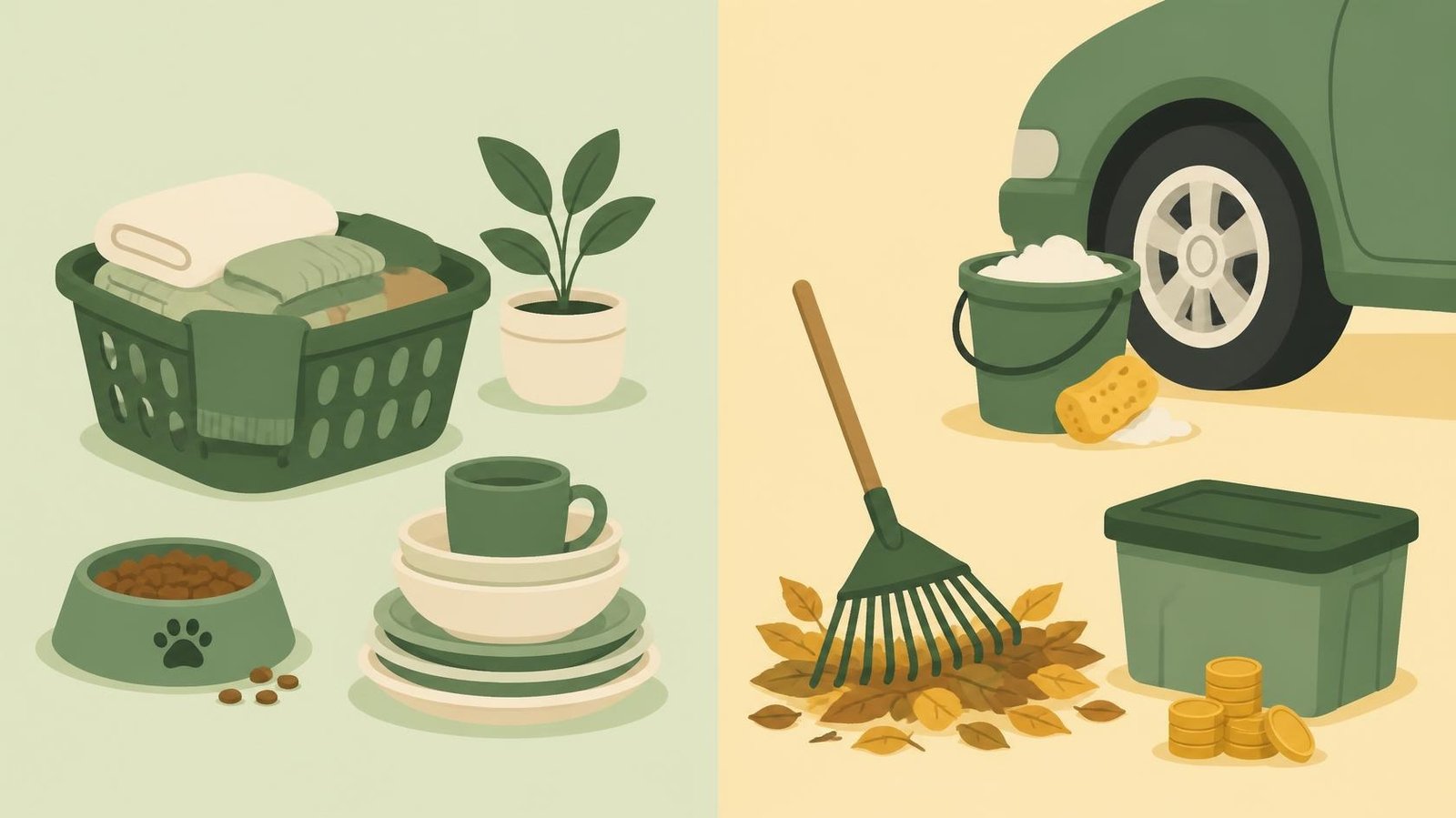
Because those lessons overlap, families often ask whether allowance should depend on completing chores. There is no universal answer. The best system is the one whose lesson is clear, whose rules fit your values, and whose administration you can sustain.
Quick comparison
| System | Core lesson | Main advantage | Main risk |
|---|---|---|---|
| Learning allowance | Practice managing a predictable amount | Money lessons continue even during a rough chore week | Child may see the money as automatic unless expectations are clear |
| Chore-based pay | Work produces income | Direct link between effort and earnings | Child may treat basic family responsibilities as optional paid work |
| Hybrid | Everyone contributes; extra work can earn extra money | Separates household membership from earning opportunities | Requires a clear list of included and extra jobs |
A 60-second decision guide
- “I mainly want my child to practice managing money.” Choose a learning allowance. Handle skipped chores with non-money consequences.
- “I mainly want my child to learn that work earns money.” Choose chore-based pay, but only for tasks you are comfortable seeing declined.
- “I want both, and basic help at home is non-negotiable.” Choose the hybrid.
- “I can’t check jobs every day.” Avoid per-task pay. A weekly learning allowance needs the least checking.
- “My child is saving for something big.” Add a small menu of optional paid jobs and connect earnings to the goal with Can My Child Afford It?
System 1: learning allowance
The child receives a fixed amount on a regular schedule. Routine chores still exist, but the allowance is not reduced job by job.
This system works well when the main goal is money management. The child can plan because income is predictable. Parents can use other consequences when ordinary responsibilities are ignored.
Best for families who want to emphasize budgeting, saving, and household teamwork as separate lessons.
Try this rule: “You receive $6 every Friday to practice managing money. You also clear the table and put away laundry because everyone helps at home.”
System 2: chore-based pay
The child earns money by completing assigned jobs. Payment may be per task or based on completing a weekly list.
This creates an easy-to-see connection between work and income. It can be motivating, especially when the child has a goal. The drawback is that a child may decide the pay is not worth the effort and decline a task that still needs to be done.
Best for families comfortable defining which jobs are paid and what happens when a job is incomplete.
Try this rule: “Each listed job has a price. We agree on the job and the standard before you start. You are paid after it is checked.”
System 3: hybrid allowance plus paid extra jobs
The child receives a modest learning allowance and completes basic household responsibilities without per-task pay. A separate marketplace offers optional, age-appropriate jobs for extra money.
Many families find this the clearest compromise. It protects the idea that family members contribute while giving children a realistic way to earn more.
Best for families who want both predictable budgeting practice and a work-for-pay lesson.
Try this rule: “Your regular responsibilities are feeding the dog and putting away your clothes. Washing the car or organizing the garage are extra jobs you may choose for pay.”
Worked example: one week, three systems
To see how the systems compare in dollars, we entered one example 10-year-old into our Allowance Builder and Chore Marketplace Builder in October 2026. These are example inputs and the tools’ results, not recommended rates.
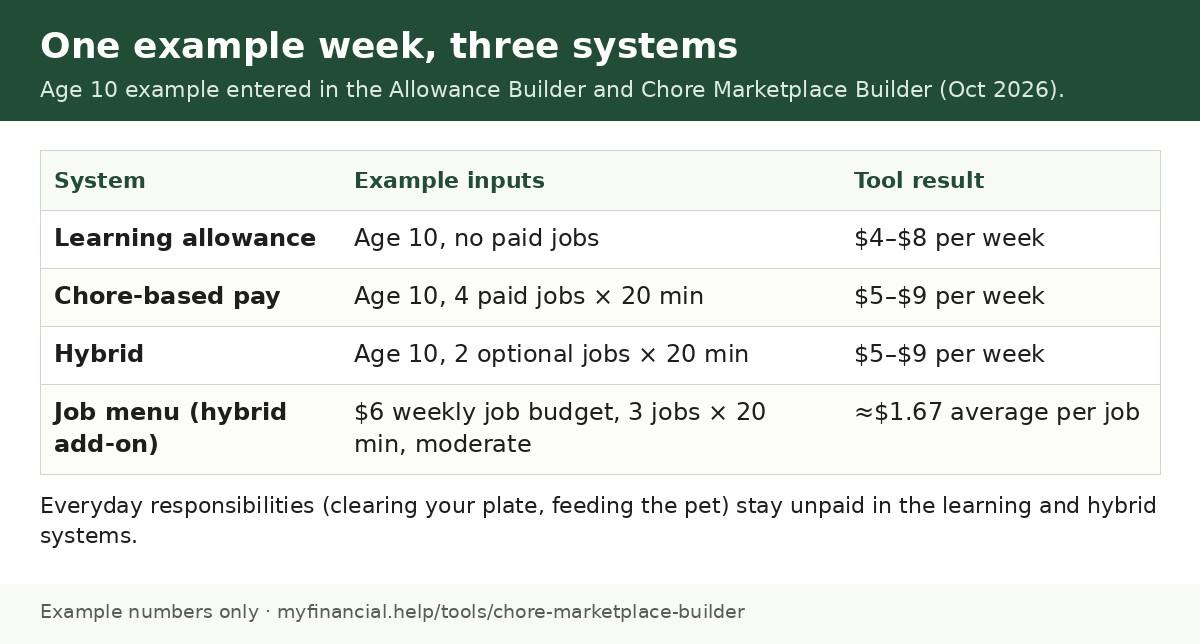
- Learning allowance: age 10, no paid jobs → suggested $4–$8 a week.
- Chore-based pay: age 10, 4 paid jobs a week at about 20 minutes each → $5–$9 a week. If only two jobs get done, earnings drop.
- Hybrid: age 10, a smaller base plus 2 optional jobs at about 20 minutes → $5–$9 a week.
- The job menu for the hybrid: a $6 weekly job budget, 3 optional jobs, about 20 minutes each, moderate difficulty → about $1.67 per job on average, capped at $6 for the week.
The totals are similar. What changes is predictability and what a skipped week teaches. In the learning system, a rough chore week does not change the budget. In chore-based pay, it does. In the hybrid, the base stays steady and only the extra earnings move.
How to separate regular chores from paid jobs
Ordinary responsibilities usually have three qualities: they recur, they support the child’s own needs or shared family life, and every capable family member contributes in some way. Paid jobs are more likely to be occasional, larger than the normal expectation, or tasks an adult might otherwise pay someone else to do.
Examples of ordinary responsibilities:
- Putting away personal belongings
- Clearing a place at the table
- Keeping a bedroom reasonably organized
- Feeding a family pet on an assigned schedule
Examples of optional paid work:
- Washing and vacuuming the family car
- Raking a large yard
- Organizing a storage area
- Helping with a one-time household project
Everyday responsibilities vs. optional paid jobs, by age
Use this as a starting list and adjust for your child’s abilities and safety. The American Academy of Pediatrics’ HealthyChildren.org chores guide has more age-appropriate task ideas.
| Age | Everyday responsibility (unpaid) | Optional paid job ideas |
|---|---|---|
| 6–8 | Put toys away, clear own plate, help feed a pet | Match and fold a basket of socks, wipe down the car’s inside doors |
| 9–12 | Keep room reasonably tidy, unload part of the dishwasher, pack own school bag | Wash the car, weed a garden bed, sort a donation box |
| 13–15 | Own laundry, a rotating kitchen task, help with siblings at set times | Rake or mow (with supervision as needed), deep-clean the garage, help with a one-time project |
| 16–18 | Cook one simple meal a week, manage own schedule and laundry | Larger projects an adult might otherwise hire out, such as painting a fence |
For more task ideas by age, see Age-Appropriate Chores for Kids and Teens.
What happens when chores are not done?
Choose consequences that match the responsibility. If a child does not put away a game, access to the game can pause until the task is complete. If a paid job is incomplete, it is not paid. Avoid changing rules in the middle of a disagreement.
For a fixed learning allowance, repeatedly docking money can make income unpredictable and weaken the budgeting lesson. For a chore-based system, nonpayment should follow a clearly defined incomplete job, not a general bad mood or unrelated behavior.
What to say when your kid pushes back
- “I don’t want the money, so I won’t do it.” (chore-based or hybrid paid job) “That’s your choice for an extra job. Feeding the dog isn’t an extra job; it’s part of living here.”
- “Can I get paid for making my bed?” “No, that one’s an everyday responsibility. Want to see this week’s list of paid jobs?”
- “My brother got paid for that!” “He did an extra job that was on the menu. The menu is open to you too, and the price is the same.”
- “I did it, so pay me.” (job not finished) “Let’s look at what ‘done’ means on the card. Once it matches, it’s paid.”
A seven-day family test
- Pick one system.
- Write the payday, amount, regular chores, and any paid extras.
- Define “done” for each job.
- Use one reminder method.
- Hold a five-minute review after payday.
At the end of the week, change only what was confusing. Do not rebuild the entire system after one imperfect week.
Our Allowance Agreement
Suggested ages 6–15 · PDF · 1 page
Agree on payday, spending responsibilities and a review date together.
Printable chores and allowance checklist
Print this section or copy it into your notes app.
- ☐ Choose a system: learning, chore-based, or hybrid
- ☐ List everyday responsibilities (unpaid)
- ☐ List optional paid jobs, each with a definition of “done” and a price
- ☐ Set a weekly cap for paid jobs
- ☐ Pick a payday and who checks the work
- ☐ Write what happens when a responsibility is skipped (non-money consequence)
- ☐ Write what happens when a paid job is unfinished (not paid until done)
- ☐ Avoid paying twice for a job already covered by allowance
- ☐ Review after one week; change only what was confusing
The decision
Choose learning allowance when predictable practice is the priority. Choose chore-based pay when the work-income connection is the priority. Choose hybrid when you want to teach both while keeping basic contribution nonnegotiable.
Use the Allowance Builder for the fixed portion and the Chore Marketplace Builder for extra jobs. For task ideas, continue to Age-Appropriate Chores for Kids and Teens.
Sources
- Consumer Financial Protection Bureau: School-age children and earning
- HealthyChildren.org (American Academy of Pediatrics): Age-Appropriate Chores for Children
- Utah State University Extension: Teaching Children Money Management
- Consumer Financial Protection Bureau: Building blocks to help youth achieve financial capability (2016)
Need a starting amount for each age? See How Much Allowance Should a Child Get by Age?
This article is for educational purposes and does not provide individualized financial, tax, legal, or investment advice. Example numbers are illustrations, not recommended amounts.




Leave a Reply