
A card from Grandma with $20 inside, a check from an uncle, a gift card at the holidays: money gifts are often the biggest amounts a child handles all year. They also arrive with feelings attached, from the giver and from you. A simple plan keeps the gift joyful, respects the giver, and turns it into real practice.
Quick answer: Treat gift money as the child’s money, with a plan. Before the holidays or a birthday, tell grandparents what your family does with money gifts (without asking for amounts). When the money arrives, help your child split it into spend now, save toward a goal, and (optionally) give, with more choice as they get older. Afterward, make the thank-you part of the gift. Keep gift money separate from allowance so it doesn’t replace your regular system.
Why gift money needs its own plan
Allowance teaches slow, steady habits: a predictable amount on a predictable day. Gift money is different. It arrives in larger, irregular amounts, often more than a month of allowance at once, and it comes from someone the child loves. That makes it a great chance to practice a bigger decision, and an easy moment for a quick, regrettable spend.
The Consumer Financial Protection Bureau’s Money as You Grow materials encourage parents to let children make real money choices and talk through them. A gift is one of the most natural times to do that.
Step 1: Talk to grandparents before the gift
Most tension around money gifts comes from mismatched expectations, not the money. A short, warm conversation ahead of time helps. You are not asking for anything; you are sharing how your family handles gifts.
Scripts for talking with grandparents
- Sharing your system: “The kids love getting cards from you. Just so you know, when they get money we help them split it into spending, saving for a goal, and sometimes giving. They usually tell you what they chose.”
- When the amounts feel too large: “You’re so generous with them. We’re trying to keep gifts a little smaller so they don’t expect big amounts every time. Would you be open to [an outing together / a smaller amount plus a card]?”
- When the grandparent wants money saved for later: “That’s really thoughtful. Would you like us to put it toward their long-term savings and send you a note when we do?”
- When cousins get different amounts: “We don’t compare between families. The kids just know Grandma sends something special.”
Step 2: Make a plan with your child when the money arrives
Sit down within a few days, while the gift still feels exciting. Count it together, say who it came from, and decide the split. Younger children need a clear frame; teens can make most of the decision themselves.
| Age | Who holds the money | How much choice | A good first plan |
|---|---|---|---|
| 3–5 | Parent | Choose between two options | Pick one small thing now; the rest goes in a visible jar |
| 6–8 | Child’s jar, parent nearby | Child chooses within a set split | Spend some now, save some toward a named goal, give a little if they want |
| 9–12 | Child, with a written plan | Child proposes the split; parent checks it | Connect the “save” part to a goal with a target date |
| 13–15 | Child or teen account | Teen decides; parent asks questions | Decide before shopping, and wait a few days on big purchases |
| 16–18 | Teen’s own account | Teen decides | Fold it into their monthly budget and longer-term goals |
A three-part split is common, but the percentages are yours to choose. There’s no correct ratio. What matters is that the child makes the decision before the money is spent. Our Save, Spend and Give Jars guide covers the jar system in detail.
Worked example: a $50 birthday gift (tool walkthrough)
Here’s an example, with made-up numbers, of a 10-year-old who gets $50 from a grandparent and has wanted $60 headphones for a while. They had already saved $15.
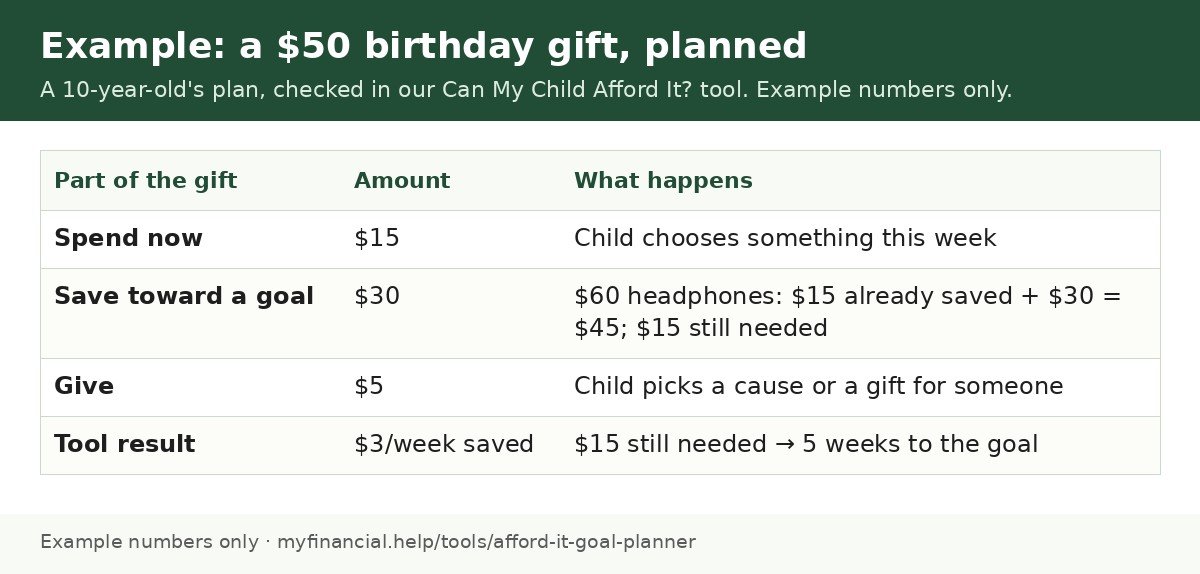
- Spend now: $15. The child picks something this week. Joy is part of the gift.
- Save: $30. Added to the $15 already saved, that makes $45 toward the $60 headphones.
- Give: $5. The child chooses a cause or a small gift for someone else.
We entered the rest into our free Can My Child Afford It? planner: item price $60, already saved $45, saving $3 a week. The tool returns $15 still needed and 5 weeks to the goal. Without the gift, the same goal would have taken 15 weeks at $3 a week. That comparison is a lesson in itself.
Gift cards: treat them like cash
Gift cards are easy to lose and easy to forget. The CFPB’s “Unwrapping gift cards” guide suggests protecting a card like cash, writing down the card number, security code, and customer service number when you first get it, and registering it if you can.
Under federal rules, the money on most store gift cards and network-branded gift cards generally can’t expire for at least five years from when the card was issued or money was last added, and inactivity fees are limited. Check the card’s terms anyway, especially for promotional cards.
- Keep gift cards in one envelope or a folder with the receipt.
- Write the balance on the envelope after each use.
- Use the card in the same “spend, save, give” plan as cash. A $25 store card might be the “spend now” part.
Larger gifts and long-term savings
Sometimes a relative wants to give a bigger amount for the future. Two facts help frame that conversation:
- For federal gift tax purposes, the IRS annual exclusion is $19,000 per recipient for gifts made in 2026. That is the giver’s rule, not the child’s, and typical birthday or holiday gifts are far below it.
- Long-term options such as a savings account in the child’s name or an education savings account each have different ownership, access, and tax rules. A family that is weighing them should look at official plan documents or talk with a qualified professional. This article doesn’t recommend any particular account or investment.
For kids, the visible part still matters. If a large gift goes into long-term savings, show the child the statement, and let them make a small spending or giving decision from it, so the gift doesn’t feel invisible.
When a gift clashes with your family’s rules
- The gift pays for something you’d said no to (a game currency card, for example). Decide whether the gift changes your rule. If not, try: “Grandpa’s gift is yours. Our game-spending rules still apply, so let’s decide what part goes to games.” See our in-game spending budget.
- A relative hands money over with “Don’t tell your parents.” Teach a simple family rule: money gifts get talked about at home. It’s about safety and honesty, not control.
- A child expects money from every visit. Gently separate the person from the gift: talk about what you do together, and make the thank-you about time, not dollars.
Step 3: The thank-you is part of the gift
The thank-you doesn’t depend on what the child chose. A card, a short call, or a photo of what they bought or how much they’ve saved closes the loop, and grandparents often love hearing the plan. For younger children, a drawing works.
Try: “Thank you for the birthday money! I spent some on ___, I’m saving the rest for ___, and I gave some to ___.”
Printable gift money checklist
Print this section or copy it into your notes app.
- ☐ Before the holidays: share your family’s gift-money approach with relatives (no amount requests)
- ☐ When money arrives: count it together and say who it came from
- ☐ Decide the split: spend now / save toward a goal / give (optional)
- ☐ Write the goal and run it through Can My Child Afford It?
- ☐ Gift cards: record the number, balance, and customer service number
- ☐ Keep gift money separate from allowance
- ☐ Send a thank-you within a week
- ☐ Check progress on the goal at your next family money meeting
Common questions
Should gift money go into the child’s savings automatically?
Many families save some of it, but if all gift money disappears into an account the child never sees, it teaches very little. Letting the child make at least one decision keeps the lesson.
Should I count gift money as part of allowance?
Usually not. Allowance is the predictable practice budget; gifts are extra. Keeping them separate prevents “I got $50, so I don’t need allowance this month” confusion. See How Much Allowance Should a Child Get by Age?
Where can we review the plan as a family?
Add a “gifts and goals” item to your next family money meeting, especially in January after holiday gifts.
Sources
- Consumer Financial Protection Bureau: Money as You Grow
- Consumer Financial Protection Bureau: Unwrapping gift cards (2025)
- Consumer Financial Protection Bureau: Regulation E § 1005.20, gift card requirements
- Internal Revenue Service: Frequently asked questions on gift taxes
- FDIC: Money Smart for Young People
This article is for educational purposes and does not provide individualized financial, tax, legal, or investment advice. Example numbers are illustrations, not recommended amounts.




Leave a Reply