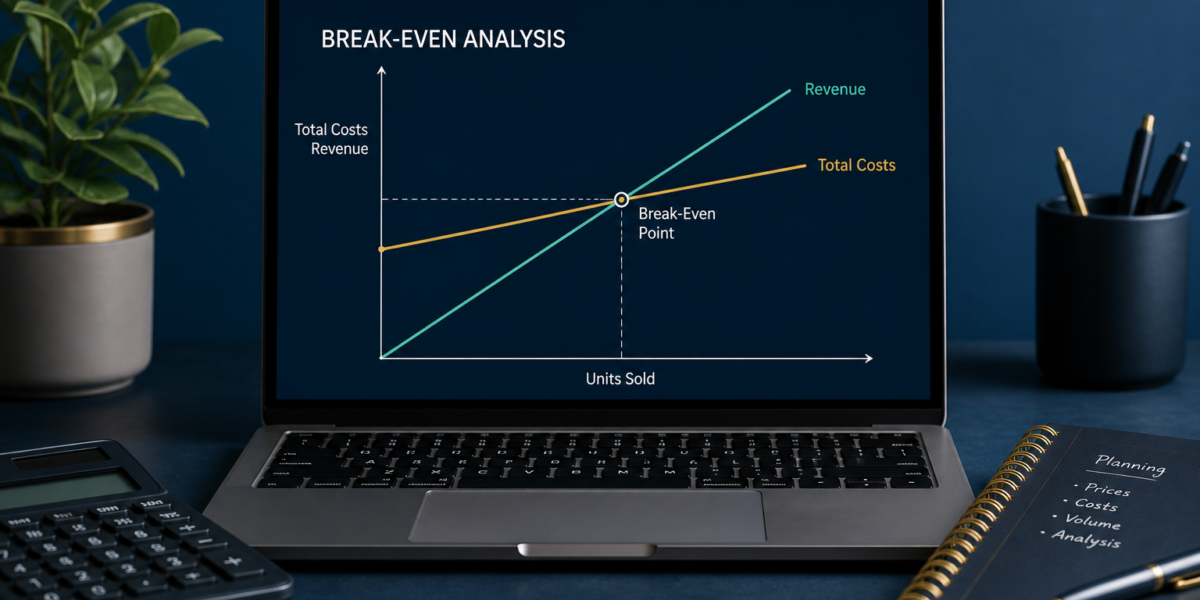
Your business break-even point is the sales level at which total revenue equals total costs. At break-even, the business has covered the costs included in the analysis but has not yet produced a profit.
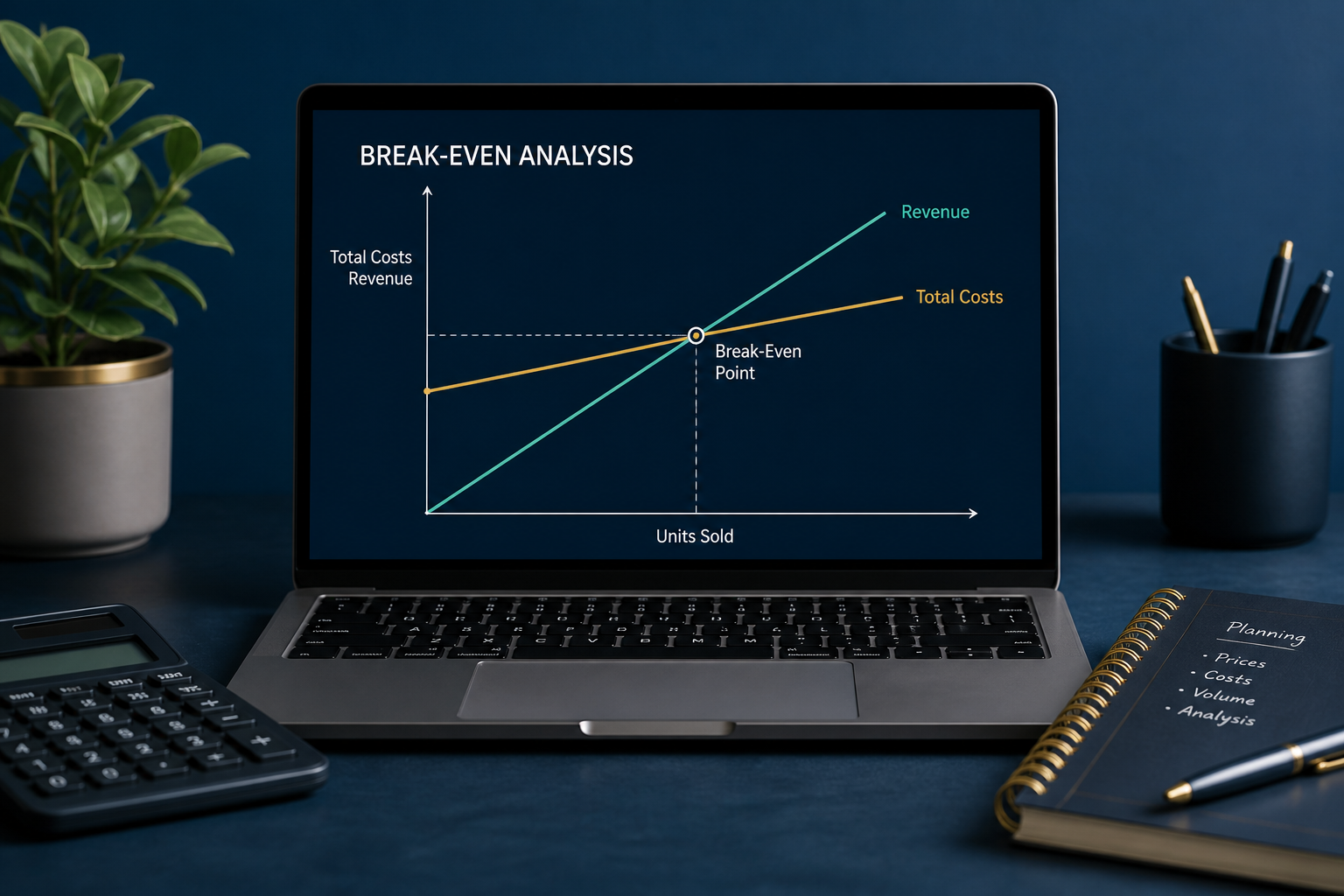
Break-even analysis can help you test prices, set sales targets, evaluate a new product, and understand how fixed and variable expenses affect risk. It is an estimate—not a guarantee—and it becomes more useful when its assumptions are reviewed regularly.
This article builds on our guides to business financial projections, fixed and variable expenses, and revenue forecasting.
What you need for a break-even calculation
- Total fixed costs for the period
- Selling price per unit
- Variable cost per unit
The SBA formula is:
Break-even units = fixed costs ÷ (selling price per unit − variable cost per unit)
The difference between price and variable cost is the contribution margin per unit. Each sale contributes that amount toward fixed costs, then toward profit after fixed costs are covered.
Step 1: Choose a consistent time period
Monthly analysis is practical for many small businesses. Match fixed costs, expected unit sales, and other inputs to the same period. Convert quarterly or annual fixed commitments to a monthly equivalent when appropriate, while retaining actual payment timing in the cash-flow projection.
Step 2: Total fixed costs
Include costs that remain relatively stable within the relevant sales range: rent, base salaries, insurance, subscriptions, professional retainers, and other contractual expenses. Do not omit owner compensation or necessary overhead simply to make the result look better.
Step 3: Calculate variable cost per unit
Include costs caused by producing or delivering one additional unit: materials, packaging, sales commission, transaction fees, and direct shipping. Separate mixed costs into fixed and variable portions when possible.
Step 4: Determine the realized selling price
Use the amount the business realistically expects to receive after ordinary discounts, promotions, returns, and product mix—not merely the highest list price.
Step 5: Calculate contribution margin
If price is $80 and variable cost is $32, contribution margin per unit is $48.
$80 − $32 = $48
Step 6: Calculate break-even units
Assume monthly fixed costs are $12,000. Divide fixed costs by the $48 contribution margin:
$12,000 ÷ $48 = 250 units
The company must sell approximately 250 units during the month to cover the costs included in the model. Since partial units may be impossible, round up when the result is not a whole number.
Break-even point in sales dollars
For a blended or service business, you can estimate break-even sales dollars using the contribution margin ratio:
Contribution margin ratio = (sales − variable costs) ÷ sales
Break-even sales = fixed costs ÷ contribution margin ratio
If the contribution margin ratio is 60% and fixed costs are $12,000, estimated break-even sales are $20,000.
How to handle multiple products or services
A blended calculation depends on expected sales mix. Estimate the weighted average contribution margin using the proportion of each product expected to sell. Because product mix changes, also calculate major offerings separately when possible.
Add a target-profit calculation
Break-even covers costs but does not create profit. To estimate the units required for a target operating profit:
Required units = (fixed costs + target profit) ÷ contribution margin per unit
Using fixed costs of $12,000, target profit of $6,000, and contribution margin of $48, required sales equal 375 units.
Test price, cost, and volume changes
Run scenarios for supplier increases, discounts, wage changes, and capacity investments. A lower price may require substantially more volume. A fixed-cost investment may increase break-even sales even if it improves long-term capacity.
Connect the result to your 12-month cash-flow projection. Break-even profit does not guarantee positive cash because collection timing, loan principal, equipment purchases, and owner draws affect cash differently.
Common break-even mistakes
Leaving out necessary costs
Missing owner compensation, maintenance, taxes, or professional costs understates break-even.
Using list price instead of realized price
Use the expected average after normal discounts and returns.
Assuming variable cost never changes
Supplier pricing, waste, shipping, commissions, and product mix can move the contribution margin.
Ignoring capacity
Confirm the business can actually sell and deliver the required units.
Treating the result as permanent
Recalculate after meaningful price, cost, staffing, product, or facility changes.
Frequently asked questions
Does break-even include taxes?
It depends on the purpose and model. Clearly document what is included and consult an accountant for tax-specific planning.
Can service businesses calculate break-even?
Yes. Use a service unit such as billable hour, appointment, project, or client, with a realistic price and variable delivery cost.
How often should I recalculate?
Review quarterly at minimum and whenever pricing, costs, capacity, or product mix changes materially.
Use break-even as a decision threshold
Break-even analysis does not predict demand. It shows what sales level your assumptions require. Compare that threshold with the evidence in your revenue forecast and revise the inputs as actual performance arrives.
Sources
This article is for general educational purposes and does not provide accounting, tax, legal, investment, or lending advice.




Leave a Reply