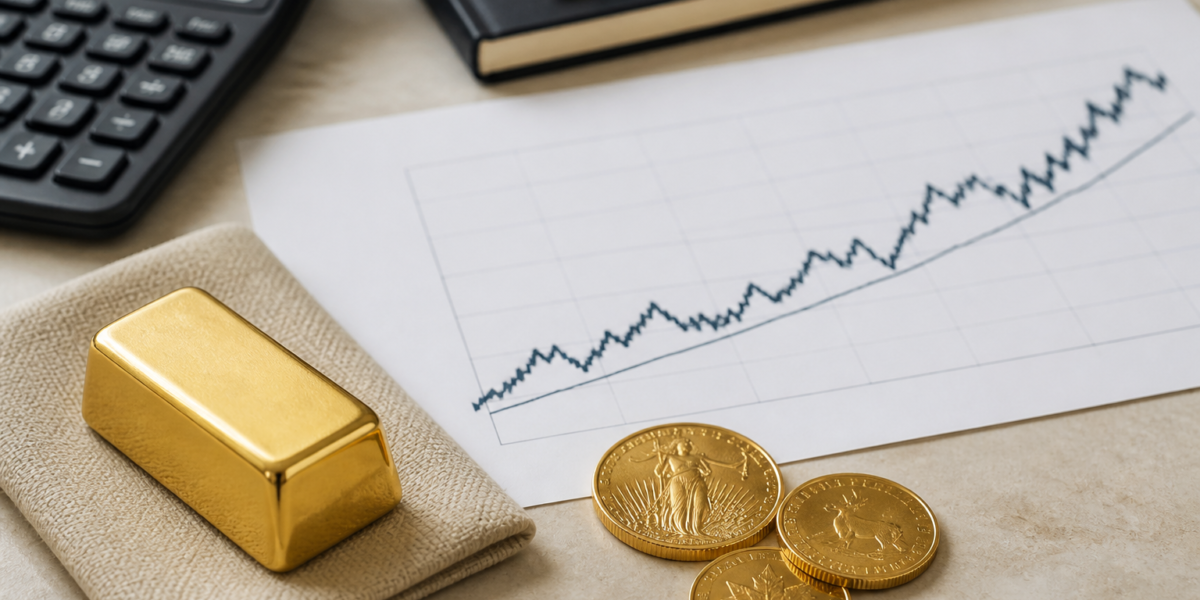
Gold has had an extraordinary run. After gaining roughly 65% in 2025, the metal broke through the $5,000-an-ounce mark for the first time in history in January 2026, touching an intraday peak near $5,589 per ounce. It has since pulled back — trading closer to $4,300 by mid-2026 — but even at that level, gold is still up nearly 30% from a year earlier. For everyday investors, that kind of move raises an obvious question: does gold still belong in a portfolio, and if so, how much?
Why Gold Has Been on a Historic Run
A few forces have combined to push gold to record territory:
- Safe-haven demand: Geopolitical tensions, including conflict in the Middle East and ongoing U.S.-China trade friction, have pushed investors toward assets seen as stores of value during uncertainty.
- Record central bank buying: Central banks purchased roughly 289 tonnes of gold in the second quarter of 2026 alone — a 62% jump from a year earlier — continuing a buying spree that’s run well above pre-2022 norms. According to the World Gold Council, roughly 89% of reserve managers surveyed expect global central bank gold holdings to keep rising over the next year.
- ETF inflows: Gold-backed ETFs pulled in a record $89 billion in inflows, pushing total assets under management in gold ETFs to an all-time high.
- Rate-cut expectations: Gold tends to perform well when real interest rates are falling or expected to fall, since it doesn’t pay interest or dividends and becomes relatively more attractive when yields on cash and bonds decline.
What the Pullback Tells Investors
Gold’s slide from its January peak to around $4,300 by mid-year is a reminder that even historic rallies don’t move in a straight line. Commodity prices, gold included, can swing sharply on shifting rate expectations, a stronger or weaker dollar, and changes in geopolitical risk. Investors who chased the January highs and bought near the peak are sitting on a meaningful pullback, even though gold is still well above where it started 2025.
This volatility isn’t unique to gold — it echoes the kind of swings that have also been rattling energy markets and equities this year, as discussed in our look at how oil price swings have been shaking markets in 2026. The lesson is similar in both cases: single-asset bets, no matter how strong the recent trend, carry real risk of sharp reversals.
Should You Add Gold to Your Portfolio?
The Case For
- Diversification: Gold has historically moved somewhat independently of stocks and bonds, which can smooth out overall portfolio swings.
- Inflation and crisis hedge: Many investors hold a small gold allocation as insurance against high inflation or acute market stress.
- Institutional tailwind: Sustained central bank buying provides a source of demand that isn’t purely driven by retail investor sentiment.
The Case for Caution
- No income: Gold doesn’t pay dividends or interest, so returns depend entirely on price appreciation.
- Already-elevated prices: Buying after a 65%-plus rally means you’re paying near-record prices, and pullbacks like the one seen since January can be sharp.
- Timing risk: It’s difficult to know whether gold consolidates from here, resumes climbing, or gives back more ground as rate expectations shift.
How Most Financial Professionals Think About It
Many advisors who recommend a gold allocation at all suggest keeping it modest — often in the range of 5% to 10% of a diversified portfolio — rather than treating it as a core holding. That’s typically enough to capture diversification benefits without overexposing a portfolio to a single commodity’s price swings.
If you’re considering exposure, common options include:
- Gold ETFs, which track the price of gold without requiring you to store physical metal.
- Gold mining stocks or funds, which offer indirect exposure but carry additional company-specific and operational risk.
- Physical gold, such as coins or bars, which involves storage and insurance costs but appeals to investors who want direct ownership.
Bottom Line
Gold’s move to record highs in 2026, followed by a real pullback, is a textbook example of how even historically strong trends can reverse quickly. Central bank demand and safe-haven buying have provided real support for prices, but that doesn’t make gold immune to volatility. If you’re thinking about adding gold to your portfolio, treat it as one diversification tool among many rather than a bet on where prices go next, and size any allocation with your overall risk tolerance and time horizon in mind.
This article is for educational and informational purposes only and is not personalized financial, legal, or tax advice. Consult a qualified financial professional before making investment decisions.




Leave a Reply