
Separating fixed and variable business expenses makes financial projections more useful. It shows which costs continue even when sales slow, which costs rise with activity, and how revenue growth may affect profit and cash needs.
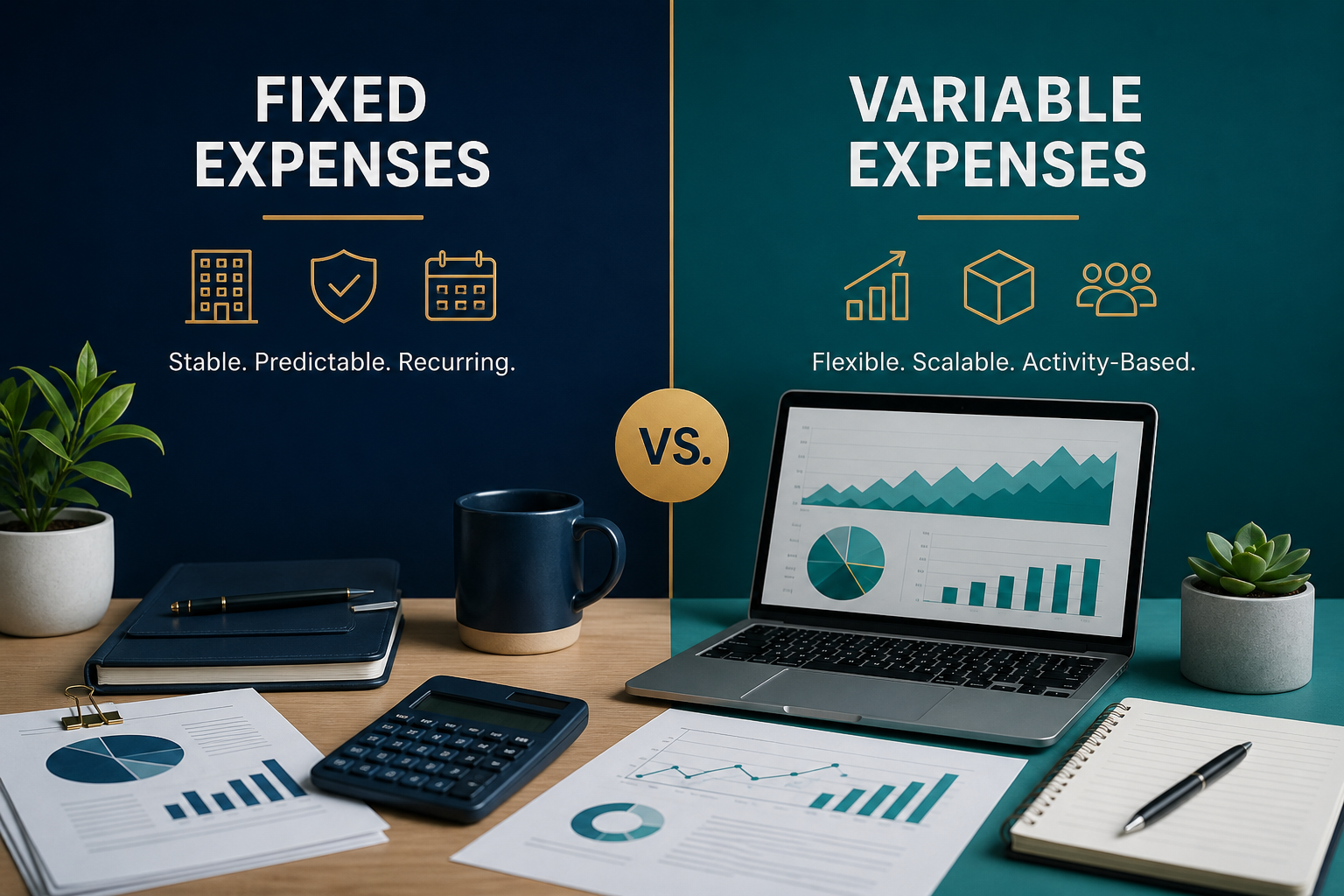
The labels are planning tools, not permanent identities. A cost can behave differently depending on the time period, contract, or activity you are analyzing. The goal is to classify each expense according to what actually drives it.
This guide supports our broader resources on financial projections, revenue forecasting, and cash-flow projections.
What are fixed business expenses?
Fixed expenses generally do not change directly with short-term sales or production volume. They are commonly based on time, contracts, or capacity. Examples may include rent, base salaries, insurance, software subscriptions, professional retainers, and certain loan payments.
“Fixed” does not mean the amount can never change. A lease can renew, insurance premiums can increase, and the company may hire another salaried employee. The cost is fixed only within a relevant range and period.
What are variable business expenses?
Variable expenses change as the company sells or produces more or less. Common examples include direct materials, packaging, card-processing fees, sales commissions, shipping, and hourly production labor when hours follow output.
For projections, express a variable cost as a rate per unit, percentage of sales, or another operating driver. This makes the cost update automatically when the revenue or volume forecast changes.
What are mixed or semi-variable costs?
Mixed costs contain both fixed and variable components. A utility bill may include a base service charge plus usage. A delivery vehicle may have a monthly payment plus fuel and maintenance that rise with miles. Payroll may include a fixed base staff plus overtime during busy periods.
The SBA recommends separating mixed costs into fixed and variable portions when possible for a more accurate break-even analysis.
Step 1: Choose the forecast period and activity driver
Classify expenses for the same monthly period used in your revenue forecast. Then identify the activity that causes each cost: units produced, orders shipped, customers served, billable hours, miles driven, or sales dollars.
Step 2: Review actual expense behavior
Use bookkeeping and vendor records to compare expenses with activity. Ask whether the cost remained stable, changed proportionally, or increased in steps. Review at least 12 months when seasonality matters.
Step 3: Build the fixed-cost schedule
Enter expected fixed expenses by month. Place quarterly and annual payments in the months when cash leaves the business for cash-flow planning. You may also calculate a monthly equivalent for profitability or break-even analysis, but do not lose sight of the actual payment date.
- Rent and facilities
- Base salaries and payroll-related costs
- Insurance
- Software and professional retainers
- Licenses and recurring fees
- Interest and other contractual commitments
Step 4: Calculate variable cost per unit
For each revenue stream, total the costs that change with one additional unit or sale. If materials are $12, packaging is $2, payment processing averages $1, and sales commission is $5, estimated variable cost per unit is $20.
Multiply the rate by projected volume. Revisit the rate when supplier prices, discount tiers, waste, shipping, or product mix changes.
Step 5: Model step costs and capacity changes
Some costs remain stable until the business crosses a threshold. A company may need another employee after a certain customer count, more warehouse space above an inventory level, or upgraded software after adding users. These are often called step costs.
Place the cost increase in the month the threshold is expected to occur. Link it to the operational assumption instead of applying smooth percentage growth.
Step 6: Connect expenses to profit and cash flow
Use projected revenue minus variable costs to estimate contribution toward fixed expenses and profit. Then transfer the actual payment timing into the cash-flow projection. Depreciation, loan principal, prepaid expenses, and customer-payment timing can make profit and cash move differently.
Example: service business expense forecast
Assume a company expects 100 service appointments at an average price of $150. Variable supplies and processing average $25 per appointment. Monthly fixed expenses total $9,000.
- Revenue: 100 × $150 = $15,000
- Variable expenses: 100 × $25 = $2,500
- Contribution after variable expenses: $12,500
- Amount remaining after fixed expenses: $3,500 before taxes and other items
If volume drops to 70 appointments, variable expense falls, but the $9,000 fixed commitment remains. That is why understanding cost behavior matters.
Common classification mistakes
Treating every monthly bill as fixed
A bill can arrive monthly while still changing with activity.
Assuming fixed costs never change
Add known renewals, hires, lease changes, and capacity steps in the correct month.
Using one variable-cost percentage for every product
Different offerings may have different materials, commissions, and delivery costs.
Ignoring payment timing
An annual expense can be spread for analysis but still create a large cash outflow in one month.
Monthly expense-forecast checklist
- Reconcile actual expenses.
- Confirm cost drivers.
- Update supplier prices and wage assumptions.
- Add known contract and capacity changes.
- Compare projected and actual costs.
- Explain major variances.
- Update the profit and cash-flow forecasts.
Frequently asked questions
Are salaries fixed or variable?
Base salaries are often treated as fixed within a period. Hourly labor, commissions, overtime, and added staffing may behave as variable or step costs.
Is marketing fixed or variable?
It depends. A monthly agency retainer may be fixed, while performance advertising or affiliate commissions may change with campaigns or sales.
Should loan payments be fixed expenses?
Separate the accounting and cash-flow treatment. Interest affects profit, while both principal and interest affect cash. Follow your repayment schedule.
Use cost behavior to make better decisions
Fixed and variable classifications help you test pricing, volume, hiring, and expansion decisions. Keep the model simple, document the driver behind each cost, and revise it when contracts or operations change.
Sources
This article is for general educational purposes and does not provide accounting, tax, legal, investment, or lending advice.




Leave a Reply