When a child lives in two homes, allowance can turn into one more thing to coordinate, or one more thing to compare. “Dad’s house pays more.” “Mom said I could buy it.” A clear plan, ideally agreed by both parents but workable even if only one home uses it, keeps money lessons consistent and keeps the child out of the middle.
Quick answer: Pick one of three setups: one home pays the whole allowance, both homes split it by an agreed share under the same rules, or each home runs its own system. Whatever you choose, keep one wallet or tracker that travels with the child, write down what the allowance covers, and never use allowance to carry messages or settle adult disagreements. Allowance is separate from child support or any court order.
Why two homes need a written allowance plan
Children adjust better when routines and expectations are broadly consistent between homes. The American Academy of Pediatrics’ HealthyChildren.org guidance on supporting children after separation encourages parents to cooperate on routines and keep children out of adult conflict. Money is a routine like any other. It just has a dollar sign on it, which makes comparisons easy.
Allowance is also a teaching tool. The CFPB’s youth research describes ages 6–12 as the years when financial habits and norms begin to form. Two conflicting systems make those habits harder to build.
Three ways to run allowance across two homes
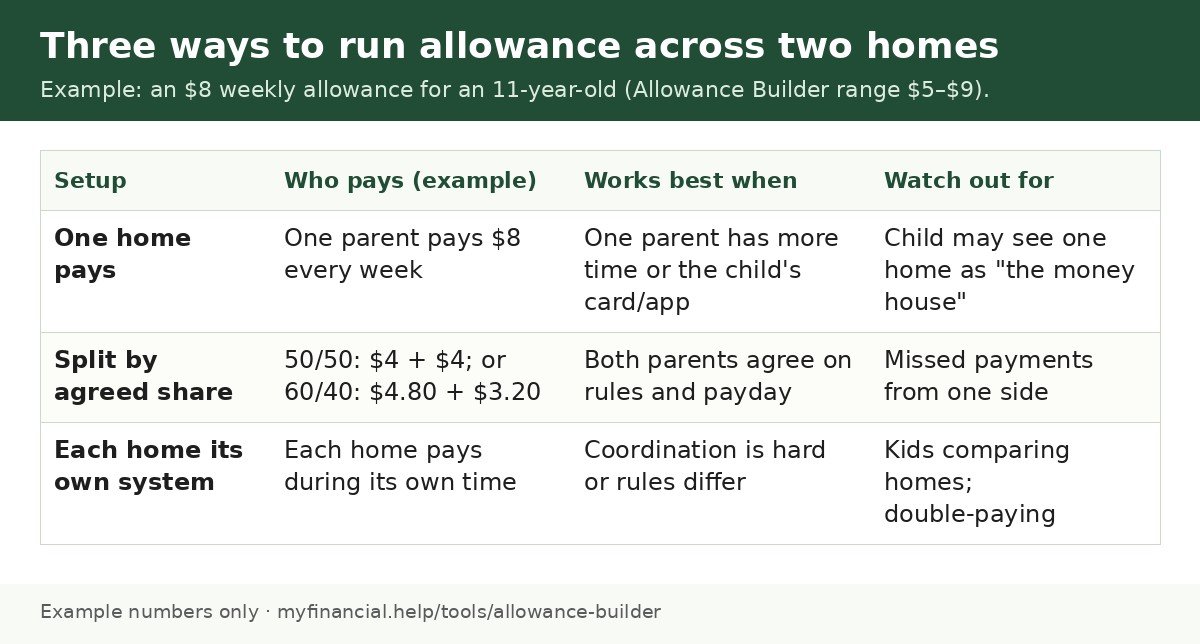
| Setup | How it works | Works best when | Watch out for |
|---|---|---|---|
| One home pays | One parent pays the full allowance on a fixed day, every week, regardless of where the child is | One parent manages the child’s card or app, or has more time to run it | The child seeing one home as “the money house” |
| Split by agreed share | Same amount and rules; each parent pays an agreed share (50/50 or another split you choose) | Both parents can agree on rules and a payday | One side missing payments; confusion over who pays what |
| Each home its own system | Each home pays during its own parenting time, with its own rules | Coordination is hard, or values differ a lot | Kids comparing homes, paying twice for the same thing |
A 60-second decision guide
- Can you and the other parent agree on a weekly amount and what it covers? Yes → split by agreed share, or let one home pay and settle up separately. No → each home its own system, with clear rules in yours.
- Does the child use one card, app, or jar? Yes → one home paying into it is simplest.
- Does the schedule change often? Yes → avoid “only during my time” payments; a fixed weekly payday is easier for kids.
Worked example: setting the amount (tool walkthrough)
Example only: parents of an 11-year-old enter “age 11, learning allowance, no paid jobs” into our free Allowance Builder. It suggests $5–$9 a week, reviewed after four weeks. They agree on $8 a week to cover school snacks and small treats.
- One home pays: $8 every Friday, no matter which home the child is in.
- Split 50/50: $4 from each parent into the same jar or account every Friday.
- Split by another agreed share, such as 60/40: $4.80 and $3.20. Some families round to $5 and $3 to keep it simple for the child.
Notice what doesn’t change: the amount the child receives, the payday, and the list of what it covers. That consistency is what the child experiences.
Keep one wallet that travels
The most practical fix for two-home allowance is physical: one jar, envelope, card, or tracker that moves with the child. It prevents “my money is at the other house” and makes the balance easy to check in either home. For older kids, a single teen account or app that both parents can view (where the provider allows it) does the same job. See How to Choose a First Bank Account or Debit Card for a Teen.
Allowance is not child support
Keep allowance separate from child support, court-ordered expenses, and any shared-cost agreement. Allowance is a small practice budget for the child. It shouldn’t be used to offset support, and the child shouldn’t be told which parent paid for what. If you have a parenting plan or court order that addresses children’s expenses, follow it. This article is general education, not legal advice.
What to say when your kid says…
- “Dad’s house gives me more.” “Each home can have its own rules. Here, your allowance is $8 and covers snacks and treats. That’s our plan.”
- “Mom said I could buy it.” “If it’s from your allowance, it’s your choice within our rules. If it needs extra money, that’s a grown-up decision we’ll talk about.”
- “I left my money at the other house.” “Let’s add the wallet to your packing list. Your money will be there next time.”
- “Can you ask Dad to pay me back?” “Grown-ups will sort out grown-up things. Your allowance is the same either way.”
A neutral message template for the other parent
Short, specific, and about the child: “Hi, I’d like to keep [child]’s allowance consistent between homes. Proposal: $8/week every Friday, covering snacks and small treats, paid into the jar that travels in the backpack. I can cover it all, or we can split it. Open to your ideas. Can we review in four weeks?”
When the other parent won’t coordinate
You can still run a clear system in your home. Keep your rules simple, predictable, and explained in terms of your home (“In this house…”), and avoid criticizing the other home’s approach in front of the child. Children can learn that different households have different rules, the same way school and home differ.
By age: what changes in a two-home plan
| Age | Simplest setup | Child’s role |
|---|---|---|
| 6–8 | One home pays into one jar that travels | Pack the jar; count it on payday |
| 9–12 | One home pays or a 50/50 split, same rules | Track the balance in a notebook or app |
| 13–15 | Teen account both parents can view, where available | Plan spending across both homes’ schedules |
| 16–18 | Teen manages own account; allowance shrinks as earnings grow | Tell both parents about big purchases |
Printable two-home allowance agreement
Print this section or copy it into your notes app.
- ☐ Weekly amount: $____ Payday: ________
- ☐ Who pays: ☐ one home ☐ split ____/____ ☐ each home during its own time
- ☐ What the allowance covers: ________
- ☐ What stays parent-paid in both homes: ________
- ☐ Where the money lives: ☐ jar/envelope that travels ☐ one account or card
- ☐ Rule for advances and running out early: ________
- ☐ Optional paid jobs? ☐ no ☐ yes, in which home: ________
- ☐ How parents will tell each other about changes: ________
- ☐ Review date (after four paydays): ________
Common questions
Should allowance only be paid during my parenting time?
It can work, but many children find a fixed weekly payday easier to plan around than one that depends on the schedule. If you do pay only during your time, say so clearly and keep the amount steady.
What about chores in two homes?
Chore expectations can differ between homes. Keep any paid jobs clearly separate from allowance so a child isn’t paid twice. See Should Allowance Be Tied to Chores?
Sources
- HealthyChildren.org (American Academy of Pediatrics): How to Support Children after Their Parents Separate or Divorce
- Consumer Financial Protection Bureau: Building blocks to help youth achieve financial capability (2016)
- Consumer Financial Protection Bureau: Money as You Grow
- Consumer Financial Protection Bureau: School-age children and earning
This article is for educational purposes and does not provide individualized financial, tax, legal, or investment advice. It is not a substitute for a parenting plan, court order, or legal counsel. Example numbers are illustrations, not recommended amounts.




Leave a Reply